Monday, January 31, 2005

Plus ça change . . .

Not everyone who reads this site will remember 1967. I remember it vividly (and not fondly). Another war. Another election. But the same old crap. Here, courtesy a blogger at Daily Kos (via Empire Notes) is the entire article in the New York Times, reporting from that (not so distant) time:
U.S. Encouraged by Vietnam Vote : Officials Cite 83% Turnout Despite Vietcong Terror

by Peter Grose, Special to the New York Times (9/4/1967: p. 2)

WASHINGTON, Sept. 3-- United States officials were surprised and heartened today at the size of turnout in South Vietnam's presidential election despite a Vietcong terrorist campaign to disrupt the voting.

According to reports from Saigon, 83 per cent of the 5.85 million registered voters cast their ballots yesterday. Many of them risked reprisals threatened by the Vietcong.

The size of the popular vote and the inability of the Vietcong to destroy the election machinery were the two salient facts in a preliminary assessment of the nation election based on the incomplete returns reaching here.

The size of the popular vote and the inability of the Vietcong to destroy the election machinery were the two salient facts in a preliminary assessment of the nation election based on the incomplete returns reaching here.

Pending more detailed reports, neither the State Department nor the White House would comment on the balloting or the victory of the military candidates, Lieut. Gen. Nguyen Van Thieu, who was running for president, and Premier Nguyen Cao Ky, the candidate for vice president.

A successful election has long been seen as the keystone in President Johnson's policy of encouraging the growth of constitutional processes in South Vietnam. The election was the culmination of a constitutional development that began in January, 1966, to which President Johnson gave his personal commitment when he met Premier Ky and General Thieu, the chief of state, in Honolulu in February.

The purpose of the voting was to give legitimacy to the Saigon Government, which has been founded only on coups and power plays since November, 1963, when President Ngo Dinh Diem was overthrown by a military junta.

Few members of that junta are still around, most having been ousted or exiled in subsequent shifts of power.

Significance Not Diminished

The fact that the backing of the electorate has gone to the generals who have been ruling South Vietnam for the last two years does not, in the Administration's view, diminish the significance of the constitutional step that has been taken.

The hope here is that the new government will be able to maneuver with a confidence and legitimacy long lacking in South Vietnamese politics. That hope could have been dashed either by a small turnout, indicating widespread scorn or a lack of interest in constitutional development, or by the Vietcong's disruption of the balloting.

American officials had hoped for an 80 per cent turnout. That was the figure in the election in September for the Constituent Assembly. Seventy-eight per cent of the registered voters went to the polls in elections for local officials last spring.

Before the results of the presidential election started to come in, the American officials warned that the turnout might be less than 80 per cent because the polling place would be open for two or three hours less than in the election a year ago. The turnout of 83 per cent was a welcome surprise. The turnout in the 1964 United States Presidential election was 62 per cent.

Captured documents and interrogations indicated in the last week a serious concern among Vietcong leaders that a major effort would be required to render the election meaningless. This effort has not succeeded, judging from the reports from Saigon.
You can read some pertinent commentary on similarities and differences with Iraq here.

Bird flu: quick weekend update (1/29 -1/31)

Quick survey of weekend developments:
  • Two more deaths, including a Cambodian woman who came over the border to Vietnam to get treated. Suspect case in Central Highlands (first such report) and seven suspect cases in Hanoi hospitals. No confirmation yet on Cambodian death or the others regarding H5N1, but it is considered likely.
Update (2/1/05): H5N1 infection as a cause of death has been confirmed in the woman from Cambodia.
  • Vietnam to host a regional meeting late in February from bird flu affected countries
The United Nations Food and Agriculture Organization and the World Organization for Animal Health will sponsor the meeting in Ho Chi Minh City from Feb. 23 to 25, according to the food agency representative in Vietnam, Anton Rychener. "Participants will discuss the control of the outbreak and the measures that could possibly be undertaken," Rychener said. (International Herald Tribune)
There are no details as to which countries will attend but last February (2004) 23 countries met in Bangkok under similar circumstances to discuss culling strategies, surveillance, carcass disposal and similar issues related to the poultry epidemic. This year's meeting will also likely look at public health issues. Twelve confirmed H5N1 deaths have occurred so far this year, all in Vietnam. The number continues to climb.
  • The disease continues to spread among poultry in Thailand, now involving six provinces. That country saw 12 deaths in last year's outbreak and is on high alert for human cases. (News24, South Africa).
  • In Vietnam 31 of 64 provinces are currently involved and almost 1 million birds have been culled. Hanoi now has a central slaughterhouse at the city's largest poultry market. Sales are usually high during the Tet (Lunar New Year) Holiday but are down 50% in the last two weeks. Last year's ban on sale and transport of poultry has yet to be repeated but birds without health certificates are being confiscated and destroyed (via Irish Examiner).
In summary, no encouraging news, much to worry about.

Stun guns: bird flu's evil twin?

What do stun guns like the Taser (other posts here, here and here) and bird flu have in common? Nothing really, except an interesting mirror image relationship in the ages at risk. Bird flu mainly strikes teenagers and young adults, in contrast to the usual endemic human influenza that kills the very young and very old. Stun guns are designed to be used on teenagers and young adults but now are being used on the very young and the very old.

Consider:
  • Police in Rock Hill, South Carolina used a Taser on a 75 year old woman in a nursing home when the woman, a distraught visitor who couldn't find her sick friend, refused to leave. The woman was further charged with trespass and resisting arrest (LA Times).
  • In Palm City, Florida, a 40 year old man was charged with domestic battery after he used a stun gun (reportedly not a Taser) on his 14 year old son for not obeying him to stop wrestling with his brothers (AP via ABC News).
Haven't had enough?
  • In Florida Miami-Dade County police used a Taser on a 6 year old emotionally disturbed first grader who broke some glass and was threatening to hurt himself with it (via Prison Planet).
"I couldn't imagine why a police officer would use that kind of device on a child," said Marvin Dunn, a psychology professor at Florida International University who was formerly a principal at an alternative school. "I can restrain a 6-year-old with one hand. I don't get it." [snip]

Miami-Dade police policy prohibits the use of Tasers only against pregnant women. Before the officer used the stun gun on the boy, Miami-Dade Officer Yolanda Rivera, who was on the scene, called a sergeant and verified its use was within department policy.

Rossman said the department's administration was reviewing its Taser policy.

Dunn said there are methods of physically restraining children and dealing with emotionally disturbed children. Clearing the room and having just one person speaking calmly to the child could have been one option, he said.

"You simply escalate the situation when you bring more adults into the picture," Dunn said.
Well it wasn't lethal force.

Sunday, January 30, 2005

10 year old Vietnamese girl has died. Victim number 12.


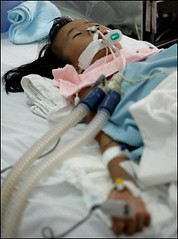
The second of the two girls noted in a previous post has now died of bird flu (via Xinhua/China View).

It is often easy to forget there are people behind the numbers. Someone's older or younger sister, best friend, their little girl. So I am posting her picture (from Agence France Presse).

A 25 year old Cambodian woman has been hospitalized in Vietnam in critical condition and is on a respirator (see Recombinomics for details). She lived in a Cambodian province bordering Vietnam. Bird flu is the presumptive diagnosis.

Update (1/31/05): The Cambodian woman has now died . It is reported her young brother had also died before being seen by medical care. If confirmed due to H5N1, this would be Cambodia's first death from bird flu. Meanwhile, another death is under investigation, a 39 year old man from Danang in the central highlands. If confirmed, this would be the central region's first case.

In addition, it is reported that seven more hospitalized cases are under investigation by Vietnam's National Institute of Hygiene and Epidemiology (update info from ABC News).

Iraq: eyes wide shut (link fixed)

While we gird ourselves for the spin machine's glorification of the Iraq "elections," take a look at the images on Trevor Davis's blog. If you can. These are the faces of suffering, courtesy the US taxpayer, among others.

A recent epidemiological study in The Lancet estimated the deaths caused directly by the invasion and occupation in statistical terms. The late Irving Selikoff, one of the last century's great epidemiologists, used to say that statistics were people with the tears wiped away. Take a look at the tears. And weep.

"Botanical antiviral": caveat emptor

There are reports from various news sources today that a "pharmaceutical" manufacturer and a distributor are "working with government and hospital officials in Southeast Asia to provide VIRA 38 for the treatment and prevention of bird flu (H5N1). VIRA 38 is on the market in Hong Kong and will be available in China and Taiwan soon."

Let me say first I am extremely skeptical of the claim that "VIRA 38", an alleged "broad spectrum anti-viral" made from botanical products, is truly effective at anything except lining the pockets of its purveyors. The further claim that VIRA 38
is known for its effectiveness in treating and preventing influenza. VIRA 38 has recently been shown to contain compounds that inhibit the bird flu (H5N1) virus. Researchers at the Chinese University of Hong Kong, have previously discovered these same compounds to be effective against a variety of pathogens including SARS CoV, the virus responsible for causing severe acute respiratory syndrome
comes without any citations or supporting documentation. I judge it highly unlikely to be true, have no reason to believe it, and have plausible reasons to think it is false.

I am purposely not linking to the company or its distributor or giving their names. Should it turn out that this is truly an effective over-the-counter preparation, we will likely have confirmation soon enough. In the meantime, expect more such claims as anxiety ratchets up.

"We're Number One! We're Number One!"

Yes, we're Number One. In sexually transmitted diseases (STDs), anyway.

And not by a little: rates of disease and disability three times higher than in other industrialized nations (Amanda Gardner, HealthDay Reporter). Using 1998 national data on sexual health and reproduction, surveillance systems for infectious diseases, hospital and outpatient statistics, birth and death records as well as published research, CDC researchers estimated public health burden in terms of the adverse health consequences of infertility, cervical cancer and HIV infections (study published in the Jan. 27 issue of the British journal Sexually Transmitted Infections). As measured by Disability Adjusted Life Years (DALYs) and premature deaths, STDs accounted for 20 million adverse health consequences and about 30,000 deaths (1.3% of US deaths). If HIV/AIDS is included, men constituted 2/3 of the deaths, but without HIV/AIDS, women were almost 90% of the deaths (from cervical cancer, associated with human papilloma virus, a sexually transmitted viral infection). (hat tip, Sam Dawes, for correction).

That's one (of many) reasons to oppose the Republican push to require teenagers to have parental consent (see here and here) for seeking reproductive health services. It is an assault on women with potentially fatal outcome.

Or maybe it's just a "family values" example of justifiable homicide for disobedience?

Saturday, January 29, 2005

Environmental red scare

The Nebraska Republican Party is scared to death. They cite the case of feedlot owner David Dickinson, whose 12,000 cattle each take in 25 lbs/day of high-grain diet on one end and put out 9 lbs of manure on the other end, producing a total of 54 tons every 24 hours. The result is a pile of manure 100 feet long, 30 feet high and 50 feet wide. Three months ago (about the time of the election) it underwent spontaneous combustion. The fire is threatening the health and welfare of the nearby residents (CNN.com).

The problem, as the local Red State fathers see it, is that they produce even more manure per day. "What if we spontaneously combusted?" one was heard to ask. Who would save the unborn?

Not to worry. There seem to be enough Democrats these days willing to fill in.

Bird flu sites

The lack of attention to the bird flu problem by the American media is perhaps not surprising (figuring out what's important and then telling us has not been their strong suit), but the similar lack of attention by the blogosphere is. However there are bloggers (besides us, that is) who have paid attention. Judging from the traffic on this site, there is considerable interest out there, so here are the links:

Just a Bump in the Beltway
Similar to this site in some ways, although not concentrating on public health. Melanie has persistently and accurately kept avian influenza in her sights.

Pathogen Alert
The name says it all. Slow server.

Recombinomics
Not exactly a blog, Henry Niman's company site has a wealth of up-to-date information on influenza. Suited to technically confident visitors with a good handle on the existing situation. Part of my daily read.

Center for Infectious Disease Research and Policy (CIDRAP)
Website of the Center at the University of Minnesota run by Mike Osterholm. Full of extremely useful information on infectious diseases and authoritative background information and news about bird flu.

ProMed Mail
Alert service used by many public health professionals that includes reports from everywhere on emerging infectious diseases, including avian flu. Tends to lag a bit behind the other sources.

CDC Avian flu site
Usually a day late and a dollar short, but background information conveniently arrayed.

Dismaying and predictable

The Center for Infectious Disease Research and Policy (CIDRAP) at the University of Minnesota has an interesting, dismaying and utterly predictable report on the WHO executive board meeting January 24. Citing an AP report (I was not able to find it) the board foundered on a resolution that would have allowed countries to ignore drug patents in the event of an influenza pandemic.

The patent override was suggested by the delegate from Thailand, which is in the midst of trying to halt a spreading epidemic of influenza A(H5N1) ("bird flu") and is a neighbor to Vietnam, where an epidemic amongst poultry already rages and human cases and deaths are being reported almost daily. The Thai delegate wished to add the patent provision to a resolution on ways to improve disease surveillance and augment research and stockpiling of vaccines, when and if one becomes available for H5N1.

The cost of a 6 week course of antivirals is about $120, beyond the reach of the nations now struggling to contain the disease (see previous post on the ethical and public health issues involved in distributing antivirals). The opponents of the resolution were delegates from the US and France, where major pharmaceutical interests are involved in vaccines and antivirals.

As I said, as dismaying as it is predictable (or as predictable as it is dismaying, take your pick).

Reuters Alertnet now reports that Hong Kong residents and mainland Chinese tourists are buying up available pharmacy supplies of Tamiflu. While a prescription drug, it is easily obtainable over the counter, with no questions asked. There is concern that indiscriminate use might lead to the development of resistance to what is now considered the drug of choice of H5N1.
"I'm worried the Hong Kong government won't respond quickly enough or take tough enough measures to prevent a mass outbreak," said one foreign resident who rushed to buy supplies for his family after word of the latest deaths.

"Doctors and hospitals could be completely overwhelmed ... it might be hard to get medical aid," he said.


[snip]

Public fears mounted after media reports that Chinese exports of geese and ducks to Hong Kong had dropped sharply in recently weeks. China said it was due to stronger demand on the mainland, but many Hong Kong residents were not convinced.

The deadly SARS virus first emerged in southern China in late 2002 and quickly spread to Hong Kong and then around the world. Chinese authorities initially suppressed news of its spread.
The bottom line was summed up nicely by WHO's Dr. Dr. Anarfi Asamoa-Baah:
As a global community we are still ill-prepared—and as long as one of us is not prepared, none of us is prepared.

[See links in left sidebar for previous posts on bird flu]

Pizza and coronary artery bypass: one stop shopping

Speaking at the Cleveland Clinic, President Bush pitched electronic medical records, calling on
doctors and hospitals . . . to move their medical records from paper to electronic files, a change that he said would improve medical care while shaving significant sums from the nation's spiraling health care bill. (WaPo).
Ah, the universal medical record, school record, retail purchase record, Patriot Act record, your "record" record. It will certainly make life easier. For a peek into what's in store, click here (Quicktime streaming video).

Friday, January 28, 2005

Bird flu: update

This blog was not intended to be a bird flu site, but the lack of attention by the major news media in this country suggests frequent updates would be useful to those interested in this subject. Moroever, the response to bird flu is symbolic of the lack of priority given to genuine public health problems by the federal government (in comparison to other issues of lesser importance to the life, health and welfare of its citizens), and symptomatic of the lack of leadership in public health generally. So we will continue to post on it until this seems no longer useful.
  • The disease among bird continues to spread in Thailand. A third Thai province is now reporting H5N1 influenza in chickens and more than 400 wild pigeons have been culled in central Thailand following the discovery of a single infected pigeon in mid-December (but not reported in the usual poultry reports). (AFP via ABCNews [Australia])
  • Vietnam is setting up a nationwide system to try to stop the spread of the disease, which this month has spread to 27 cities and provinces and led to the forced culling of over 800,000 birds (News24, South Africa)). Details of the new effort are still not clear, but what is clear is that they are making a major effort to confront the problem. The Vietnamese equivalent of CDC will collect samples (blood?) from people at high risk for infection (poultry workers?) and individuals in "bird flu hot spots." If properly implemented such a system could produce extremely valuable information, assuming there is sufficient time.
  • China will vaccinate poultry and supervise markets and live poultry transportation. Japan is stockpiling the antiviral oseltamavir (Tamiflu) sufficient to treat 20 million of their population of 127 million people. The US reportedly has a total of 6 million doses for our 300 million people (see previous post). Japan is also readying plans to limit travel abroad and at home and to close schools if a pandemic begins. Hong Kong has strict vaccination requirements for chickens and plans to double its Tamiflu stocks (via Reuters Alertnet)
  • The Italian health ministry has called a meeting for February 3 to "make an analysis of the risk on the base of current new information and pinpoint possible scenarios . . . There is a real danger for public health which doesn't allow for delays" in strategy, according to a ministry statement (AP via ninemsn [Australia]).
  • Meanwhile, two Vietnamese girls (10 and 13 years old) in the south are the latest to test positive for H5N1 infection. Both are in critical condition and on respirators. The mother of the 13 year old died several days ago. They had slaughtered a duck previously (time interval not known from this report). The 10 year old's family buried sick birds at the house a month previously (this seems a rather long incubation period) (via ChinaView). The disease claimed a tenth victim in the north (News24, South Africa). Five more people in Vietnam are suspected of having contracted the disease and been admitted to the hospital (EastDay, PR China). Thus the total cases since the end of December appears to be 16, of whom 10 have died as of this date. It is difficult to keep track of the individual case reports coming out of Vietnam, so the numbers are continually being revised as better information becomes available.
Update (1/29/05, 12:30 AM EST): The 13 year old girl has now died, making this the 11th death this month. The 10 year old remains in critical condition (Channel NewsAsia).
  • The virus continues its mutation. Henry Niman reports on some new information at Recombinomics.
Update (same day, 11:45 am EST): Things continue to move as more health authorities recognize the magnitude of the problem. The Manila Times is reporting that the Philippines will continue to ban all poultry imports from affected areas; install disinfectant footbaths at seaports, airports and poultry farms; and forbid capture or killing of migratory birds (a seasonal practice in some areas of the Philippines). Farmers will be encouraged to keep livestock away from lakes and marshes where wildfowl are prevalent. In addition, surveillance will be increased and pamphlets on bird flu distributed nationwide.

Update (same day, 3 pm EST): Malaysia, is the latest government to sound the bird flu alarm (Daily Express News, Kuala Lumpur, Eastern Malaysia). It has placed its 135 hospitals and 4000 clinics on high alert in the event bird flu makes its way from Thailand and Vietnam.

Update (same day, 8:30 pm EST): Word is now on the far east wire services that Vietnam has deployed armed riot police at checkpoints around Ho Chi Minh City (formerly Saigon) in the south where bird flu is epidemic among poultry and some dozen human cases have occurred (Reuters via Khaleej Times, Dubai). These armed police are augmenting traffic police who are checking and monitoring poultry transport into the city to stop infected or uncertified birds from entering. Authorities have started to destroy chickens and ducks of unknown origin. Reports suggest that this has sparked resentment among the affected population. Travel agents are being instructed not to take tourists to areas now burdened with infected poultry.

At this rate, Americans will soon be the least informed people in the world regarding bird flu.

Friday Catfloggin'

Friday is usually Blogrollin’ day, where we highlight a blog—for whatever reason. Because we like it, we hate it, because we think it will do someone some good. This was a great suggestion from Political Site of the Day (PSotD), meant to replace the ubiquitous Friday catblogging. But today I want to do catblogging.

Actually, I don’t much like cats. I’m pretty much a dog person. But this thing is just so weirdly fascinating--and it even has some public health content. It is also too long to paste the whole thing in, so here is the link (via Cruel Site of the Day) where you can take in the full argument to your heart’s content. Here is a taste of what you’ll find (the bracketed sub-headings are mine). Bon appetit:
Are cats for true Christians? Is it appropriate for a Christian to own a cat, in light of their past pagan religious affiliation and the medical information that is now coming to light? -J.R., U.S.A.

It would be misleading to answer this question with either a simple 'Yes' or a 'No.' The Scriptural answer of necessity must be a 'qualified' one, and it is easy to see why. Many conscientious ones among Jehovah's people today have wondered if Christians should own cats in view of their somewhat sordid symbolic history and the many health risks associated therewith. [snip]

[Cat means beast in Greek]

First, let us consider what most scholars agree is the etymology (word derivation) for the English term 'cat'. When analyzed with the Latin 'felis cattus domesticus', the original Koine Greek is 'cur.io huma bes-tia', means 'a contemporary housecat with all of its beastly identifying characteristics and behavior.' A faithful servant of Jehovah would quickly notice that the nature of a cat is so marked as being 'beastly'. The Bible makes clear reference to this condition when describing parts of Satan's organizations, both past and present. [snip]

[Cats should be classified with snakes]

Clearly, the Bible - by using this kind of terminology - shows beyond any reasonable doubt that the basic nature of cats, while created perfect by God, has become evil or 'beastlike' since the fall of Adam six thousand years ago, and more probably, since the Great Flood of Noah's time (c2350 B.C.E.). This is a development of the condition borne by the 'Original Serpent', the 'Great Dragon' Lucifer himself. (Gen. 3:1) Indeed, modern studies of classification of cats, while not necessarily being reliable as they may be based on the discredited 'theory' of evolution, strongly associate felines with serpents (despite some external differences in physiology and morphology, which confuse those who do not study these matters deeply). [Chris Mooney, Pharyngula and your ilk, take notice!] [snip]

[Cats were not, not present at the Party]

The Bible does not say that cats were not present at Herod's birthday party when John the Baptist was beheaded. History shows that cats were most likely present at this tragic party that Jehovah did not approve of. Clearly then, as loyal Christians, why would we even want to associate with animals that are without a doubt of such bad influence, remembering how true are the Bible's words: 'Bad associations spoil useful habits'! -1 Cor. 15:33. Some have exposed themselves to possible spiritual contamination in this way. To invite cats in our house is to toy with disaster. Can one deny that the chance exists that the same grave consequences could visit your home that fell upon John? Clearly, God disapproved of this 'birthday' party. Should we not then disapprove (without showing any malicious intent, only Godly hatred) of cats the way the scriptures recommend? [snip]

[Cats might create a condition of hospitalization]

But, the most modern scientific evidence also supports the Biblical view. Contrary to popular beliefs among worldly people, cats are unhygienic animals. Recently the Centers for Disease Control (CDC) announced that 'Cats .. can shed Salmonella in their feces, which can spread the bacterial infection to humans'. Salmonella (salmonella typhimurium) creates a condition of 'week-long diarrhea, abdominal cramps and in some instances, hospitalization.' Would we be showing the proper respect to our life, Creator and to our 'neighbor' by exposing ourselves and others to this potentially deadly disease? [snip]

[Cats don’t get married]

Additionally, cats practice many unclean habits not befitting a Christian household: coughing up fur balls, licking inappropriate body areas on their own bodies (inappropriate handling) and even, in some cases, on the bodies of their human owners (wrongful motive?), urination on the floor, vocal and blatant promiscuity (unknown to any other species, all others being endowed with Godly chastity and decorum) and widespread sexual misconduct without the benefit or sanctity of holy matrimony, even orgiastic practices, substance abuse of catnip (an intoxicating herb) which produces conditions akin to drunkenness, stealing food from the table, producing ungodly sounds, excessive playfulness and the employment of devices not known to have been used by Jesus, the conducting of its unholy business under the cover of the darkness of night, and so on. [snip]

[Cats eat meat and don’t even cook it first]

It must not be forgotten that the feline is a killer. It eats mice and their kind, which is forbidden to Christians and their pets (Lev. 11:29, Isa. 66:17). But, far more serious, is the matter of the wanton consumption of the undrained corpses of the victims of this nocturnal creature; eating bodies filled with God's sacred blood is not a matter to be trifled with (Gen. 9:3,4; Lev. 3:17; Deut. 12:16,23,24; Acts 15:20,28,29). . . [snip] . . . [W]e have shown that it would be improper for a Christian to permit a veterinarian to give blood transfusions to his pet, for animal feed known to contain blood to be served to a pet or a farm animal under one's jurisdiction, or to employ any fertilizer that is known to have blood in it (w64 2/15 127-8). By allowing one's cat to roam uncontrolled, the Christian becomes a willing party to, even a conspirator within, this serious breach of God's law of life. [snip]

[It’s OK for a cat to get stoned]

The question of how to dispose of one's unwanted cat is a serious matter. Would it be proper to hand over such a creature of Satan to a person of the world? l. . . [snip] . . . If, on the other hand, [you took the view] that the pet or any other animal is under the ultimate jurisdiction of a Christian, who therefore bears responsibilities (Eccl. 12:13,14; Jas. 4:17, 1 Pet. 3:21) that are essentially parental in nature. The cat is a dependant. In harmony with this, surely it is the parent's obligation before God to ensure the feline pet is treated as one would an unruly child who repeatedly refused to obey its parents, or of one who committed apostasy. Unfortunately in the case of human offspring, one is limited by the laws of the higher authorities of the land as to what scripturally-ordained punishment may be meted out, as compliance with both sets of laws is necessary in such areas. This may not always be the case in terms of felines, where the fact that we are not living in theocratic countries may not prove such an impediment to what God requires of us, as manmade law may not afford such unmerited protection to cats as it does to humans. [snip] 'Then all the men of his city must pelt him with stones, and he must die.' . . . [snip] . . . We are not living today among theocratic nations where such members of our fleshly family relationship could be exterminated for apostasy from God and his theocratic organization, as was possible and was ordered in the nation of Israel in the wilderness of Sinai and in the land of Palestine. 'Thou shalt surely kill him; thy hand shall be first upon him to put him to death, and afterwards the hand of all the people. And thou shalt stone him to death with stones, because he hath sought to draw thee away from Jehovah thy God. . . [snip] . . . Of course, we can take no legal responsibility for anything which results from your voluntary application of your interpretation of such Biblical principles as you may believe that we have brought to your attention.

[Cats are OK during Bush’s second coming]

As loyal followers of Jehovah's thinking on this matter, we can rejoice in the fact that in the new system, the incoming theocracy and World Order, the 'lion will lie down with the lamb' -Isa. 11:6-7. Yes, when Satan is finally abyssed, the 'beastly' nature of felines will be forever abolished, and they will be fit companions for humans on Paradise Earth! [snip]
For those interested in something completely different, on January 30, Brent Rasmussen's Unscrewing the Inscrutable will host the first Carnival of the Godless. Posts from a godless perspective from all over god's green earth have been submitted and selected by the organizers. You can read Effect Measure's entry there (actually link back to it here). And if you have one of your own, today (January 28) is the cut-off for submissions.

Thursday, January 27, 2005

Bird flu: select agents and red tape

If you want to know how badly coordinated the federal effort on bird flu is, consider this piece (from Henry Niman at Recombinomics)
US Classifies Pandemic Flu Vaccine as a Select Agent

Recombinomics Commentary
January 24, 2005

One of the more interesting facts to emerge from the University of Michigan symposium on Pandemic Influenza: Could History Repeat Itself? was the fact that the US declared the flu virus a select agent because it had been genetically modified to REDUCE its lethality.

Highly pathogenic influenza A virus, including H5N1, have a poly-basic cleavage site in the hemagglutinin protein. To make the virus less lethal and enhance virus production in eggs, several of the basic amino acids are genetically removed,.

However, the removal of these sequences placed the virus in the "select agent" category, requiring background checks and paperwork that would significantly delay development of the vaccine. WHO has been pushing for programs to delay the looming pandemic, saying [.pdf] that each day allows for 5 million more doses of vaccine to be made.

It wasn't clear how long it took to get the designation removed, but the clinical trials scheduled to begin this month are now at least 4-6 weeks away for Aventis. Chiron is stated to begin even later because they built a special testing facility for pandemic flu vaccine development.

Bird flu is looming large as the red tape flows out of Washington.
To understand exactly what this designation means practically, here are a few requirements for working with a Select Agent (from the CDC FAQ on Select Agents):
18. Who has to have a security risk assessment?

All entities (except for Federal, State, or local governmental agencies), the RO [Responsible Official of the institution], alternate RO, and all individuals with access to select agents or toxins must have an approved security risk assessment. Please see our website http://www.cdc.gov/od/sap/securisk.htm or the FBI website http://www.fbi.gov/terrorinfo/bioterrorfd961.htm for additional information. [my emphasis]

19. Please provide us with additional guidance on security risk assessments and security requirements.

Section 73.8(b)(Security risk assessments) states that an entity may not provide an individual access to a select agent or toxin unless the individual has been approved by the Secretary of either HHS or USDA, based on a security risk assessment conducted by the Attorney General. "Access" as it is used in these regulations takes its ordinary meaning: "the freedom or ability to obtain or make use of." Anyone, including visitors, who have the freedom or ability to obtain and make use of a select agent or toxin, must be approved. Also see section 73.11(d)(1) (Security). However, the regulations do recognize that access to a select agent or toxin can, as a practical matter, be limited by either security containers or by escorts. As provided in 73.11(d)(2) regarding non-laboratory functions including routine cleaning, maintenance, and repairs, non-approved individuals will be allowed access to areas where select agents are accessible only if they are escorted and monitored by an individual who has been approved. It is the intent of the regulations that the escort will have the means and ability to prevent the non-approved individual from obtaining or making use of any accessible select agent or toxin in that area.

With regard to record keeping, Section 73.15(a) requires that an entity keep an up-to-date list of everyone who has been approved for access to select agents and toxins. Section 73.15(c)(1) requires that an entity must maintain a record of each individual who has actually accessed a select agent or toxin. Section 73.15(c)(2) requires that an entity must maintain a record of each individual who has actually accessed any area where select agents are used or stored. Depending on the circumstances, maintenance of some of the records may be manual or electronic (e.g., electronic key cards that records access to labs). The record may consist of one list or three, but each section of the regulations requires the entry of specific information. For example: For a researcher working directly with a select agent or toxin, the record must show the name of the researcher; the name of agent or toxin; if long-term storage or holding was involved, the dates of removal and returns; and, if a toxin, the quantity removed and returned. Another example: For a maintenance person doing routine cleaning of an area (i.e., a lab) in which a select agent or toxin was stored (even locked storage), the record must show the name of the person who had entered the area, the date and time the person entered and left; and, if escort is required, the name of the escort.

20. What is the general process for obtaining a security risk assessment (SRA)?

The following process applies to a new application or an amendment to an existing application.

* The entity Responsible Official (RO) submits an application or amendment that includes a Table 4B (CDC Form 0.1319/USDA Form 2044) to their lead agency (APHIS or CDC, but not both). The lead agency serves as single point of contact for an entity and is responsible for coordinating all activities and communications with respect to new applications or amendments;
* The lead agency issues back to the entity a letter with the unique Department of Justice (DOJ) identifying number for each individual listed on the Table 4B or amended 4B;
* The RO forwards to each individual their unique DOJ identifying number;
* The individual fills out FBI form (FD-961) and puts their unique identifying number in block 17;
* The individual follows all of the FBI instructions (http://www.fbi.gov/hq/cjisd/takingfps.html) for submitting fingerprints; and
* The individual mails the FD-961 form and fingerprint cards as one package directly to the FBI, Criminal Justice Information Services Division (CJIS), not to APHIS or CDC.

Texan to sell earth's ecosystems

Here's something that won't surprise you: Decisions Investments Corporation of Texas is looking to sell the earth's environment. Or their piece of it. They own Biosphere 2, the 1.27 hectare glass-enclosed attempt to replicate various of earth's ecosystems (Science Magazine, 307:349, 2005). Built in the 1980s by another Texas billionaire, the facility (located in Oracle, AZ) has been plagued throughout its life (on earth) by technical problems, like maintaining proper oxygen and carbon dioxide for its resident "bionauts" who were meant to test whether humans could live in the sealed collection of mini-ecosystems. Columbia University took a crack at maintaining the facility but bailed out in 2003.

So DIC is selling the ecosphere to the highest bidder. Of course this is just a miniature ecosphere within a larger ecosphere. And maybe inside it is another one. And maybe outside the one we live in is another one, too. All owned by Texans.

Looked at in that light, the statements of DIC VP Martin Bowen take on new meaning: "we are seeking a right (sic) buyer who can keep the project going for the long term." Sounds like The Plan to Save Social Security.

Wednesday, January 26, 2005

The New England Journal's bird flu articles

On Monday The New England Journal of Medicine (NEJM) provided Early Release on-line versions of three articles related to avian influenza A(H5N1). [NB: These articles were available without subscription until today, when the print version was published. The NEJM's practice shutting off Open Access to material of such importance is not just annoying but irresponsible. Links are provided below for those wishing to purchase individual copies or who have subscriptions or access through their institutions.]

The main paper is an original research article, detailing an investigation into a cluster of three cases in Thailand in the summer of 2004. It shows likely person-to-person transmission from an 11 year old girl (who may have had contact with infected birds) to her mother and to her aunt who both cared for her during her fatal illness (Probable Person-to-Person Transmission of Avian Influenza A (H5N1), K. Ungchusak and Others ). The mother died but the aunt, treated with the antiviral oseltamavir (Tamiflu), survived. Examination of the genetic sequence of available viral specimens did not suggest that a fundamental mutation allowing facile human-to-human transmission had occurred in the virus. Thus this appears to be an example of the rare person-to-person transmission of the disease which has been suspected in some other circumstances, but not documented as here.

The paper was accompanied by a Perspective (The Threat of an Avian Influenza Pandemic, A.S. Monto ) and an Editorial (Avian Influenza and Pandemics — Research Needs and Opportunities, K. Stöhr ). Stöhr is with WHO's Global Influenza Programme. His Editorial adds little to what he and others have said previously. Monto's Perspective, however, deserves some additional comment. Here is the "money quote":
But what if recognized transmission does begin to occur in a limited geographic area? Isolation and quarantine, which have proved effective against the severe acute respiratory syndrome (SARS), will probably not be sufficient to stop the spread of such an infection. Vaccine specific for the new strain will not be available for months after its appearance in humans . . . .

We know that the neuraminidase inhibitor oseltamivir inhibits the type A (H5N1) viruses. It might be possible to achieve local control of an incipient outbreak among humans by using oseltamivir for prophylaxis in the contacts of patients as well as for treatment in the infected persons themselves. Treatment of patients alone would not prevent further spread, but it might reduce the shedding of the virus and would, in any event, be required for ethical reasons. All these actions rely on early recognition through good surveillance and the ability to deliver the antiviral drug at a time when transmission might still be inefficient.

The logistic hurdles are formidable. A mobile stockpile of the drug would have to exist and be made available in the affected country. Oseltamivir is now being stockpiled by a number of developed countries for use once a pandemic virus becomes established and begins to spread rapidly around the globe. Developing a stockpile in an attempt to restrict the spread of the new virus at its source might mean diverting drugs from other national stockpiles. However, this diversion must happen. The notion of trying to control a pandemic at its source would have been considered laughable just a few years ago — but that was before SARS transmission was controlled by public health measures. We have no idea whether a type A (H5N1) virus that was fully adapted to humans would continue to be highly lethal, but it is nevertheless incumbent on the global community to try to contain it.

The avian origin of previous pandemic viruses was recognized only after the fact; this time, we have been given a warning. We really are not sure when, or whether, the type A (H5N1) virus will start to spread among humans, but we must be ready to stop it if we can — and, if we cannot, at least to mitigate its effects through the use of stockpiled antiviral drugs and, eventually, strain-specific vaccine.
It should be noted that Monto properly reported he received consultation fees and grant support from Roche, the drug company that makes oseltamavir (Tamiflu). Since he is advocating the use of this antiviral it presents an unfortunate appearance of a conflict, but it is probably true that for the moment oseltamavir is the only (medical) game in town and his comments seem reasonable and plausible. Assuming this, it raises several questions.

First, what are the US stocks of oseltamavir and where are they? According to speakers on Monday at the National Bioterrorism Conference in Ann Arbor, Michigan, the US Strategic National Stockpile (SNS) has only 2 million doses of oseltamavir, although Federal officials have "talked" about increasing it to 10 million, still a woefully inadequate supply. It is estimated that there may be another 4 million doses in regular commercial channels in the US (via Pathogen Alert). We note that Hong Kong alone has 1.7 million doses and expects to double this by mid year (via Reuters Alertnet). So much for adequate planning.

But Monto's Perspective also raises some important ethical questions. Oseltamavir can be used either for prophylaxis (prevention) or early treatment. In the face of short supply, who will get the drug and how will it be partitioned between prophylaxis and treatment? Thus there are important questions of rationing and allocation for our own population.

But there is an additional, international question. Monto's Perspective implies that a country not yet affected might send its scarce supply of antiviral agent to a country where an epidemic might be getting underway, like Viet Nam or Thailand. The hope would be that we could stop the epidemic before it becomes a pandemic, thus protecting people globally. But if we miss, then the donating country would have even less stock. Australia is a country with a relative (per capita) excess of oseltamavir. Alan Hampson, deputy director of WHO's Collaboration Centre for Influenza in Melbourne has already suggested the best use might be to send a portion of it to stamp out an outbreak elsewhere (via The Australian).

Thus among the broad range of experts we will need in the event of a pandemic, bioethicists will be among the most important.

Or maybe not. We could just leave it to the good, family values-based moral judgment of the Bush Administration. Do you feel safer now?

(See sidebar for links to other posts on bird flu.)

Tuesday, January 25, 2005

Bird flu and bullshit

CDC's concerns about bird flu are just barely poking their head above water, but at least some signs are visible. The Denver Post reported this week (byline Anne Mulkern) that the agency is readying quarantine and school closure plans and examining how to ration vaccine. Since there is no vaccine for bird flu yet, this is rather curious. CDC is also asking states to get pandemic plans ready.
"The situation is different than it's ever been before" with the avian flu, said Dr. Ken Gersham, chief of the communicable-disease program at the Colorado Department of Public Health and Environment. "I think it is scary to people who know a lot about flu and what could happen."
Indeed. I think we (and others) have been saying that for some time (see links to previous posts in sidebar on left).

Now that the rest of the world is awake, we are starting to rewrite public health history in this country (from the Post story):
"When you look at health threats, here is one that we essentially know is going to happen," Dr. Bruce Gellin, director of the U.S. Department of Health and Human Services' vaccine program, said of a flu pandemic. "We don't know when it's going to happen. We don't know how severe it's going to happen."

Planning for such a pandemic began about two years ago.

Former Health and Human Services Secretary Tommy Thompson told Gellin, a specialist in infectious disease, that a national pandemic plan was his "No. 1, 2 and 3 priorities." A draft was issued in August and is posted online. No date has been set for a finalized report.
I have no doubt that there are knowledgeable people within CDC and DHHS who are, and were, scared to death of this thing. There are plenty of competent and dedicated public health professionals in the federal employ. But the implication that this has gotten the high level political support commensurate with the size of the threat is . . . well, what's that technical phrase for this . . . bullshit?

High level political support requires making a serious concern visible and public so that adequate resources can be allocated by cash-strapped state health departments who need urgent reasons to shift around the paltry contents of their shrinking pots of money. This didn't (and wasn't going to) happen during the election campaign when the Bush Administration didn't want to remind people about the flu vaccine fiasco, how dependent we were on the rest of the world or how we face threats not related to the "axis of evil."

Meanwhile, the ninth fatality has occurred in Viet Nam, a 17 year old (via Pro Med). Teenagers and young adults are disproportionate victims, unlike usual influenza were it is the very young and the very old.

There is always concern about "creating panic" by being too frank about the possibilities, given there are also significant uncertainties. Sometimes public anxiety is useful, however, and this is one of those times. As we have noted before, the Bush Administration has never been shy about issuing frightening alerts when it suits their purposes. But in this case, they would also be alerting the public to the fact that adequate preparation for a tangible threat has not happened, a threat of reasonable probability that would make an al Qaeda attack and even the tsunami look like a powder puff .

Is this an Administration that we can trust to "keep us safe"? Some questions answer themselves.

Lakoff - XI: The Moral Toolbox

[Preamble: This is one of a series of posts about the relevance of the work of George Lakoff for public health. First a disclaimer. My aim here is not an explication of all of Lakoff, or where he stands in cognitive science versus analytic philosophy, or whether there is a "there, there" as Gertrude Stein once wondered about Oakland (where Lakoff is now situated at UC Berkeley). It is rather to take some elements of Lakoff's writings (and I think genuine insights), and see how they might illuminate a central problem in public health, having a Central Problem. Posts will be relatively short, as befits the medium. PF is Lakoff's book, Philosophy in the Flesh (1999). MP is Moral Politics (2002)]

It is time to sum up Lakoff's underlying theoretical machinery. This will bring us to his Family Metaphor for Politics, the point where most people begin. I have started much farther back in Lakoff's thinking because I believe its value lies less in the specific formulation and more in the underlying method. As one passes from his earlier work to his most recent precis of MP, Don't Think of Elephants, one is struck by how much of the motivating ideas drop away, until in the short, but popular summary (...elephants) none of it is left.

This has two undesirable effects. The first is that we are led to either accept or reject a specific application of his method (his particular formulation of the Family Metaphor); and second, that to the extent we accept that formulation we run the risk of using it mechanically and uncreatively. Lakoff himself has applied it to a variety of questions, sometimes very convincingly, sometimes much less so. To the extent one finds his analysis unconvincing one might also be led to reject the whole package. I think this would be a grave error as there is much of value there. And to the extent we allow him to apply it to fields with which he is very unfamiliar (and here I am talking about public health), we run the risk of winding up with an unsatisfactory analysis. It seems to me that if one sees value in some or much of what Lakoff has alerted us to (see Lakoff VII), it is better that a Lakoffian analysis be done by experts in an area who appreciate the method than by someone who is a Lakoff expert unfamiliar with the content or by an expert in the content ignorant of the method.

After ten posts I will summarize (appropriately enough) with a metaphor of my own, the Moral Toolbox.

When we think politically, we reason with moral concepts. That reasoning is done metaphorically, that is, it uses images, concepts and bits and pieces of grounded experience that is not itself specifically moral. There are many such metaphors in our moral concept toolbox, although they don't all produce the same results and not all are equally useful in all circumstances. The tools themselves are derived from living in the real world (they are embodied). Our politics are largely determined by which tools we prefer to use when making political and moral inferences.

You can think of identity politics in terms of these tool preferences. Do you think of yourself as a plumber or a carpenter? This will determine which tools you pick up to solve particular problems. While it is true that "to a man with a hammer the whole world looks like a nail," it is also true that if you present the problem as involving a threaded pipe, even a carpenter will pick up a wrench. Carpenters may prefer hammers, but they aren't stupid and they know how to use a wrench when a wrench is appropriate. Instead of carpenters and plumbers, Lakoff presents us with Strict Fathers and Nurturant Parents. They each have roughly the same toolbox of moral concepts, but each prefers to use some tools rather than others.

Lakoff's claim in both PF and MP (but not in Elephants) is that on strictly empirical grounds, the tools the Strict Father uses will not bring about the claimed or desired effects, i.e., that the moral virtues claimed by political conservatives cannot be produced by a Strict Father morality. Lakoff considers this an established result of psychology, sociology and cognitive science. It is not an ought but an is.

The moral political metaphor of The Family is our next stop.

Links to previous posts on Lakoff in the side-bar.

Monday, January 24, 2005

Utility industry's "Quick! Silver"-therapy

Election over, it's time to recall some of the things that whizzed by us when we were otherwise occupied. Consider the Bush Administration's "Clear Skies" initiative, the perfect example of 1984-speak, seeing as how most knowledgeable observers (including a National Research Council panel) believe it will not clear the skies but make them dirtier. Among the toxins covered by Clear Skies is the heavy metal mercury, a recognized neuro- and developmental toxin (according to the EPA's own mercury website). Our chief source of environmental mercury is emissions from coal-fired power plants. Under a Clinton Administration proposal the nation's 1,100 coal-fired plants would have to reduce mercury emissions 90 percent within three years, but under "Clear Lies" they have until 2025 to reduce mercury by 70 percent. Is that clear? The cost to the utility industry, by EPA estimates, is less than 1 percent of its annual revenues (Cathy Zollo, Naples (FL) Daily News).

Apparently that's too much. Of course the utility industry is already committed to wise and responsible stewardship--of their profits. They've made substantial investments already via contributions to the campaign of President Doesn't Care and his congressional toadies which paid off handsomely, resulting in EPA stenography of industry dictated mercury rules.

We're not speaking figuratively, here. We're talking literally. A year ago when everyone was fastened on the Democratic primary campaigns, The Washington Post (link via The Seattle times ) reported that industry lobbyists had written large portions of the mercury rule. Senator Patrick Leahy asked EPA Administrator Mike Leavitt for an explanation in a written request that included as attachments a series of incriminating documents. You can see them for yourself via links here. Particularly revealing is Attachment G (.pdf), a side-by-side language comparison of the "EPA proposed rule" and industry memos/reports.

This Administration doesn't care if its mercury policy jeopardizes the potential of our children as long as it rewards their patrons in the utility industry. What does this say about their values?

My pharmacology professor in medical school used to say the only disease elemental silver was good for was "itchy palm disease." Boy, he got that right.

Sunday, January 23, 2005

Bird flu tsunami headed this way?

Since Bouphonia has done us the honor (and saddled us with the responsibility) of keeping the blogosphere updated regarding bird flu, we report the latest news. It is not reassuring.
  • There is another confirmed bird flu death, a 35 year old woman from the Mekong Delta (South). Add this to the death of a 17 year old boy in the North and the total is nine deaths since the end of December.
  • The 22 year old sister of the deceased teenage boy is now ill. H5N1 illness has not been confirmed (but see next), nor is it yet known if she cared for her brother when he fell ill. But as reported in a recent post here there is already disquieting evidence of secondary person-to-person transmission in the case of the 42 year old who cared for his (now deceased) 45 year old brother. Now comes news that a third brother, 36 years old, has been hospitalized. While all three shared a common meal of blood pudding made from ducks and pigs, they did not become ill simultaneously but at intervals of nine days each. This argues strongly for person-to-person transmission, in this case over three (viral) generations, a possible indication that human infection is becoming more likely.
Update (1/26/05, 10 pm EST): CIDRAP now reports that WHO now says (contrary to the WHO post of earlier in the day) the third brother was hospitalized only for observation and is not a case. This means this is a single person-to-person transmission of one viral generation similar to the recently reported Thai cases (see post, The New England Journal's bird flu articles, link in sidebar)
  • The disturbingly high case-fatality rate (in excess of 70% so far) continues. Viet Namese health authorities are also describing the severe respiratory distress syndrome as becoming "more complex." Henry Niman at Recombinomics suggests this may be evidence of further genetic changes in the virus.
  • Cases initially described as negative for H5N1 (the two brothers mentioned above being examples) were subsequently confirmed as positive for the virus. Niman suggests (here and here) this, too, may be evidence of a mutating virus. He makes the following important argument. Influenza A viruses have two ways to change their genetic composition, reassortment and recombination. Most of the attention has been on reassortment. The virus is unusual in that its eight genes are in separate segments. If there is co-infection with a human influenza virus, these segments can mix and match ("reassort"), to produce a virus where some of the genes can come from H5N1 and some from (say) a human H1N1. But the individual segments (genes) can also recombine "internally," so that the H5 gene from the bird can acquire some of the characteristics of the H1 gene from humans (such as being able to attach readily to human lung cells), but still look to the immune system like an H5 virus, to which we have no pre-existing immunity. A recombination affecting the H5 gene in the bird virus might be the reason that initial tests fail to confirm the disease. An H5 recombined gene, while still H5, now "looks different" to the initial tests, which are based on antibodies to an unrecombined H5.
  • As reported here, the disease among poultry continues to spread exponentially in Viet Nam. New data confirms this:
The Ministry of Agriculture and Rural Development reported on Saturday that bird flu has spread to 232 communes in 23 cities and provinces nationwide, with more than 500,000 chickens, ducks and quails being culled. After Hanoi and Ha Nam, Hai Duong is the third locality in the northern region to be affected by bird flu . . .
  • Thailand is now reporting more disease, this time including fighting cocks and chickens.
WHO remains cautious in its interpretation of these events, noting that "sporadic" human cases would be expected in an area where the disease among poultry is so widespread. But those on the spot are less hesitant (Business Day via Bloomberg):
“There is a real danger to let this wave wash away what may turn out to be a bigger problem for the country if we have an avian flu pandemic,’’ WHO representative to Thailand William Aldis told reporters in Bangkok. “The situation in Vietnam has given us all a bit of a shock.’’
So there you have it. A viral tsunami. But this time it won't "only" affect eight countries. If ever there was an issue of "Homeland Security" this is it. If this virus were a terror suspect, on the basis of public health intelligence we would be on Red Alert. They are going to blow it again.

NB: Henry Niman at Recombinomics does an excellent job of tracking developing events, although much of his commentary is technical in nature. Recommended for professionals and technically confident laypersons.

Lakoff - X: Thinking about morality metaphorically

[Preamble: This is one of a series of posts about the relevance of the work of George Lakoff for public health. First a disclaimer. My aim here is not an explication of all of Lakoff, or where he stands in cognitive science versus analytic philosophy, or whether there is a "there, there" as Gertrude Stein once wondered about Oakland (where Lakoff is now situated at UC Berkeley). It is rather to take some elements of Lakoff's writings (and I think genuine insights), and see how they might illuminate a central problem in public health, having a Central Problem. Posts will be relatively short, as befits the medium. PF is Lakoff's book, Philosophy in the Flesh (1999). MP is Moral Politics (2002)]

When we move from the experiential basis for moral concepts (discussed in Lakoff - VI) to moral accounting (Lakoff - IX) we are making the move from non-metaphoric to metaphorical thinking. Lakoff notes that while there is nothing inherently metaphoric about "Health is good" or "Everyone should be protected from physical harm" [PF, chapter 14], the incorporation of these concepts into moral conceptual systems is done through the use of metaphor. This is a basic empirical claim of Lakoff, that we think, reason and understand our experience via metaphors. Moral accounting, with its basis in the simpler metaphor of well-being as wealth, is one example. There is a certain universality about human moral conceptual systems because they are experientially grounded. But different cultures at different times might vary considerably in the more complex metaphors they use and the priority they give to different coexisting metaphors. Thus, to give one of Lakoff's examples, western thought values Moral Balance, but Japanese thought weights it more heavily than we do.

Thus moral concepts are neither completely free and unconstrained, nor are they absolute. They are not free and unconstrained because they are, as Lakoff says:
. . . inextricably tied to our embodied experience of well-being: health, strength, wealth, purity, control, nurturance, empathy, and so forth. The metaphors we have for morality are motivated by these experiences of well-being, and the ethical reasoning we do is constrained by the logic of these experiential [sources] for the metaphors. [PF p. 331].
But because our experiences of what constitutes and promotes well-being is conditioned culturally and historically, these concepts are not absolute nor do they have the same priorities for everyone. Thus Lakoff should not be accused of either moral relativism or moral absolutism. His machinery is flexible enough to avoid either. Instead our moral concepts, like other conceptual systems we use, have an "imaginative character" which allows change and adaptation as situations change and we learn and adjust.

Lakoff makes a special point that the moral metaphors with which we think and reason mostly come from conceptual structures that we would not think of as "ethical." Just as the metaphor of Love as a Journey may reason via a metaphor of vehicular travel (see Lakoff - IV for the example "Our relationship is spinning its wheels"), moral thinking often uses metaphors we would not consider to involve morality. Moral Accounting, and Well-being is Wealth, are prime examples. There are other moral metaphors as well. A pertinent one for us is Morality as Health (leading to ideas of moral hygiene, moral purity, moral soundness, being morally diseased or depraved, etc.). There is also Moral Empathy, Moral Nurturance, Morality as Strength and a number of others (see PF Ch. 14). These different metaphors are not inherently consistent and can collide, leading to different inferences. When they do, which metaphor dominates, that is, how metaphors are ordered, becomes important. Lakoff takes up this theme when he considers the priority structures of the Strict Father (politically conservative) versus the Nurturant Parent (politically liberal) moral structures. Before we get to Lakoff's notion of the Family Metaphor for Politics, we need to sum up the theoretical machinery, which we do in the next post.

Links to previous posts on Lakoff in the side-bar.

Saturday, January 22, 2005

Taser "software update"

For some reason I just can't let go of this Taser thing ("Out of my cold, dead hands . . ."). They are in the news again (New York Times; and see previous posts here and here), this time because they have quietly introduced a new and improved version with 14% more stun power. For those who don't know the delightful details, a Taser is a gun that shoots a dart with an attached wire (made by the good folks at Taser International, "Saving Lives Everyday"). When it hits its "target" it delivers an electric shock (nothing major, just 50,000 volts) that causes Electro Muscular Disruption (EMD). EMD is produced by multiple electrical pulses delivered over about 5 seconds which causes the "target's" voluntary muscles to contract and relax repeatedly. That makes fine muscle movements (like walking or standing up) difficult.

How effective are they? That depends on whom you ask. Sometimes too effective, with news reports suggesting about 80 deaths. Taser says these deaths are just coincidences: drug overdoses that would have occurred anyway. That's a good one.

But wait! Some people say that they don't work well enough. Sometimes "targets" are still able to move, breaking the wires. I guess that could be a problem, because while some "suspects" might choose to run away, some might be pretty damn mad and if all you had to defend yourself was a Taser that didn't work all that well . . .

Too effective? Not effective enough? I guess by the GoldiLocks Principle, so beloved of politicians with whom no one agrees, that Taser has it "just right." But they are not resting on their laurels (which include an investigation by the Securities and Exchange Commission for possible "order stuffing" to buck up their stock prices). In their new citizen's model, the X26, the gun's software has been updated to deliver 95 pulses over 5 seconds instead of the previous 19 for the first two seconds and 15 for the last three (look for the OpenSource version on SourceForge one of these days: GNUgun?). If you are keeping count, this is 95 pulses/5 seconds compared to the old 83 pulses/5 seconds. Fourteen percent more. "We are constantly striving to optimize our technology," the Taser spokesthing said in a statement.

Oh, I probably should have warned you at the outset. Don't bother reading this if you live in the communist states of MA, RI, NY, NJ, WI, MI, HI, since Tasers aren't legal in those lawless places. But Tasers are "not firearms" so in the rest of the country they are just fine to carry and don't even require a permit (this includes California, which goes to show you . . . well, I don't know what it goes to show you).

If you want one of these nifty gadgets--just for fun, to shock your friends or to stun your co-workers--it will set you back $999 (this is a pretty good price; I wouldn't pay $1000 for it, though. They hit my price point). Here is the company's patient package insert, as we say in the pharmaceutical biz:
The X26c Taser series offers the highest take-down power available. With Advanced new shaped pulse™ technology, the X26c TASER's Electro-Muscular Disruption (EMD) technology temporarily overrides the central nervous system, taking over muscular control. EMD technology debilitates the toughest targets, without causing injury or lasting after-effects.

Package Contents:

1 Taser X26c w/integrated laser sight
6 15' Air Cartridges
1 User Manual
1 Training DVD
1 Practice Target
1 Soft Personal Carry Case
1 Training Voucher/registration card
  • SKU: 26009
  • Specifications
  • Size: 175 cm3 (10.7 cubic in.) 15.3 cm x 8.2 cm x 3.3 cm (6.0” x 3.2” x 1.3”)
  • Weight: 175 grams (0.45 pounds / 7 ounces)
  • Power Output: Shaped Pulse Discharge 50,000 Peak Voltage 2.1 Milliamps Average Current (0.0021 Amperes)
  • Range: 0-4.6 Meters (0-15 ft) plus contact stun backup capability
  • Digital Power Magazine (DPM): Power Source w. Lithium Energy Cells and Digital Memory 6-Volt Input, 10-yr shelf life, 200 firings at 25°C
  • Energy Cell Indicator: 99% - 00% Remaining Energy Level
  • Digital Pulse Controller (DPC): Automatic 10 sec burst (interruptible) 0-2 seconds: 17 pulses per second... 3-10 seconds: 10 pulses per second 11-20 seconds: 10 pulses per second 21-30 seconds: 10 pulses per second
  • Clothing Penetration: Up to 5 cm (2 inches)
  • Temperature Range: -20 C (-05°F ) to 50 C (122° F)
  • Target Illumination: 650 nm laser sighted to center grouping at 13 feet plus two super bright LED’s for Low Intensity Illumination (LIL)
  • Cartridges: 15 ft. range, 1800 PSI nitrogen propellant, classified by U.S.B.A.T.F. as non-firearm, reversible design with 8° probe separation angle.
  • Central Info Display (CID): 2 digit LED displays remaining level, burst time, warranty expiration and illumination status
  • Safety: Ambidextrous levers with Safe “S”, Fire “F” markings
  • Holster: Soft holster with rotating clip
  • Patents: U.S. #5,078,117; U.S. #5,771,663 and others pending U.S. and Worldwide.
  • Warranty: 1 year standard, extended warranties available

Friday, January 21, 2005

Hitting the bird flu snooze alarm again

I considered making this an update of the previous post, but it is really too important not to let stand on its own. WHO is now saying they believe Viet Nam's seventh death from bird flu in Hanoi infected his younger brother who was taking care of him (via Helen Branswell, CNEWS, Canada). While possible the brothers were infected from the same meal of sick duck, the nine day gap between onset of their illnesses argues against it, according to Klaus Stohr, WHO's chief influenza specialist in Geneva. At this point there is no evidence of further transmission in the family or the immediate community, but if confirmed this would be the fifth case of person-to-person transmission of H5N1 since the disease appeared in humans in 1997.

Despite the infrequency of occurrence, experts sound increasingly worried:
"I still am absolutely convinced that it is still just a matter of time in Southeast Asia before this thing blows," said Dr. Michael Osterholm, director of the Center for Infectious Disease Research and Policy at the University of Minnesota.

"One day we're likely to wake up and find a number of people in a given household, in a particular work area, in a given village where we've got evidence of widespread transmission - and we no longer can account for that through bird-to-human transmission."
WHO's Stohr is equally pessimistic:
"I would like to believe that it's not going to happen. I would like to believe we will continue to see individual cases which are not going to be transmitted. I would like to believe this virus is not reassorting," he said.

"Unfortunately all the data we have would tell us otherwise.... There is too much at stake just to hope for luck."
Somebody needs to tell President Bush that it's not democracy and freedom that is likely to spread around the world under his "leadership." Instead of cavorting at obscenely costly inaugural events he should be instructing his public health establishment to sound the alarm that we may soon come under attack by a Virus of Mass Destruction.

Unfortunately the response to the Viet Nam wake-up call seems to be to hit the snooze alarm once again. Just a few more minutes sleep, please.

Many people voted for Bush because they thought he would "keep us safe." Now that's irony.

Still more bird flu in Viet Nam - and Thailand

With the death of an 18 year old woman, the toll from bird flu in Viet Nam has now reached six since early December. Xinhua Net (PR China) is reporting that WHO has been told by Viet Namese officials there are up to ten more suspect cases under investigation, four in the North (Hanoi), two of which are on respirators. Viet Nam has banned imported poultry and distributed hundreds of thousands of informational brochures warning against eating sick birds or coming in contact with them. This is a time (Lunar New Year) when poultry is a traditional holiday dish throughout the country, a symbolic offering to a family's ancestors. The disease continues to spread among poultry as well, with a reported case in a chicken in neighboring Thailand, an indication the epidemic is moving beyond Viet Nam. Thailand is on high alert. Migratory wildfowl such as ducks may be the source.

Appropriately, WHO is increasing the urgency of its warnings:
. . . recent epidemiological and laboratory studies revealed unusual features that "suggest that the virus may be evolving in ways that increasingly favour the start of a pandemic", the agency said in a report to its bi-annual executive board, which is meeting this week. (via Reuters)
Among the worrisome changes are an increase in environmental persistence and survival of the virus, an expanding range of species, including mammals, and the presence of the virus in migratory wildfowl, especially ducks, that are themselves healthy but excrete large amounts of virus highly pathogenic for chickens. The common practice of keeping backyard domestic chickens and ducks in rural areas means there is a potential for substantial human exposure. One scenario of great concern would be co-infection of a person with both H5N1 avian virus and a commonly circulating human strain (e.g., H1N1 or H3N2). The result could be a reassortment of genes leading to a new avian virus adapted to and easily transmissible between humans. If such an event were to occur it is possible the new virus would be less virulent in humans than the current H5N1 but no one knows. The worst case is a 1918 style (or worse) pandemic with a highly contagious influenza virus against which there is no natural immunity in humans.

If this happens, most locales are unprepared. As WHO notes,
"Many of the public health interventions that successfully contained SARS (Severe Acute Respiratory Syndrome) will not be effective against a disease that is far more contagious, has a short incubation period, and can be transmitted before the onset of symptoms," [WHO] said.

Travel restrictions, quarantines and tracing of cases will be the main tools to protect populations, pending a boost in vaccine supplies, according to the WHO. "Each day gained could mean an additional five million doses of vaccines," it said. (Reuters)
It continues to be dismaying, if not "scandalous," that there is no greater sense of urgency coming from CDC or DHHS.

Update, 1/21/05, 2:30 pm EST: Henry Niman is now reporting on a seventh death, this time in Hanoi, thus the first in the North. As usual, he has details and sober Commentary. China Post has a pointed quote from WHO's representative in Thailand, Hans Troedsson:
"It's a bit of a disappointment to have this outbreak and the international community not responding more adequately to this threat," Troedsson said. "If you had this situation in Europe or London or New York ... you can imagine how much resources would be put toward this."

WHO has a team of four people in Vietnam working on the bird flu outbreak.
The news just keeps getting worse.


Blogrollin' Friday: Billmon

On Friday we highlight a blog we feel might be of interest to our readers (all seven of them). This idea was suggested by the Political Site of the Day blog:
Even if you regularly add blogs to your blogroll, pick one blog on Friday, add it to your blogroll, and give a little blurb as to why you selected that blog. No reciprocation needed - just a way and a day to weekly, structurally, habitually, add to the connectiveness that are blogs.

And - if you like this idea, please feel free to promote it today so others can consider it as well.
Today we celebrate the return (for how long?) of the inimitable Billmon (at the Whisky Bar) ("Free thinking in a dirty glass"). Here is what Helmintholog wrote about him, and I cannot but agree:
Of all the people I have discovered from blog reading, the most journalistically talented is Billmon, whoever the hell he is. It’s not so much that he is a good writer: there are lots of people out there who can write with angry terse eloquence, even if not enough do. But he is a great editor. He really understands the art of arranging fragments into a bigger story. The Independent really ought to hire him to edit their fancy pages.
Here is Billmon's Wednesday's offering:
Sounds Like Victory

From where I sit in Iraq, things are not all bad right now. In fact, they are going quite well . . . In the distance, I can hear the repeated impacts of heavy artillery and five-hundred-pound bombs hitting their targets. The occasional tank main gun report and the staccato rhythm of a Marine Corps LAV or Army Bradley Fighting Vehicle's 25-millimeter cannon provide the bass line for a symphony of destruction.

Lt. Col. Tim Ryan
Tacoma News Tribune
January 18, 2005

You smell that? Do you smell that? That's napalm, son. Nothing else in the world smells like that. I love the smell of napalm in the morning. You know, one time we had a hill bombed for twelve hours. When it was all over I walked up. We didn't find one of 'em, not one stinkin' dink body. The smell — you know that gasoline smell — the whole hill. It smelled like . . . victory.

Lt. Col. Bill Kilgore
Apocalypse Now
1979

Thursday, January 20, 2005

Poll shows half of country is wrong

Headline from CNN's Inside Politics:

Praying that my grant gets funded

There is a line of thought that says the only intellectually honest position on religion is agnosticism, since any proposition on the existence of the Big Guy is not susceptible to proof or empirical demonstration. Thus both theism and atheism are matters of faith. Since I am an atheist, on the basis of that impeccable reasoning, I demand my fair share of the $1.17 billion federal money shelled out to "faith-based" programs last year (Laura Meckler, AP, via the Boston Globe).

I know I have to do more than just ask for it, so in my latest grant proposal I have included a diagram that clearly shows a cross, a Star of David and a crescent over my workspace. To those who object I don't really believe in what those symbols represent, I reply as did Niels Bohr when asked by a reporter if the horseshoe over his lab bench meant he was superstitious. "Of course, not," he replied. "I'm a scientist. But I understand it works even if you don't believe in it." So we'll see.

If funded, as a tithe, I will donate my institution's full federal indirect costs to my atheist co-religionists fighting the infidels of Intelligent Design.

Peace be with us all.

Wednesday, January 19, 2005

When epidemiology is rocket science

When Russians launch their space rockets from the Baikonur Cosmodrome in Kazakhstan they also spray "dozens of litres of unburned fuel from spent rocket stages containing toxic substances" onto an inhabited area surrounding the site. US and European launch sites are over the ocean and do not result in this kind of civilian exposure. Reuters Health reports that epidemiologists from Vector, the Russian weapons laboratory in Novosibirsk, have found "increased rates of illness" in children along the flight path. The Russian report is not published, but noted as a news item in the journal Nature (subscription required) because of its "important implications." Nature also reported that Russian authorities deny the report and are attempting to suppress it.

NASA and the European Space Agency have used the facility and admitted to being aware of the pollution, but don't accept responsibility, saying they are only "buying the service" of the cosmodrome. The ever-popular American weapons-maker Lockheed-Martin also uses it.

I guess we really are all in this together. Makes you proud.

Tuesday, January 18, 2005

Implausible deniability at NIH

WaPo is reporting that NIH has buckled under pressure from scientific publishers and gutted its new Open Access proposal. That proposal, which was set to be announced last week, would have asked researchers to deposit NIH funded research papers in the National Library of Medicine's Pub Central repository within 6 months of publication, making them freely available to the public. The new plan would push that back to one year, a time when many publishers already make their content publicly available. NIH Director Elias Zerhouni denied that the change was in response to intense pressure applied to NIH by lobbyists for commercial publishers and the Association of American Publishers, whose president, Patricia Schroeder, is a former congresswoman from Colorado. With this denial, Zerhouni is lying, plainly and simply. Another "water carrier" for the Administration.

But the fight continues on other fronts. One of the evolving norms of science is that it be "open." I say "evolving" because historically scientists often kept essential elements of important scientific discoveries secret. Newton is a notable, but hardly unique example, declining to reveal crucial optical experiments he performed. But in the twentieth and now the twenty-first century, science has become a cooperative if not a collaborative enterprise. Except in mathematics, it is usual to see multi-author papers, many having half dozen or more authors representing different expertise and often disparate parts of the world. When supported by taxpayer dollars, it seems only proper that scientific knowledge be freely available, especially in public health which is a global enterprise. Science that is not available and accessible to the world scientific community does not fit into the agenda of public health science.

Here, as in other areas of "intellectual property" (why isn't this considered an oxymoron?) the battle lines are being drawn. Despite the NIH cave-in, the Open Access movement gains ground daily (see previous post) and many scientists are experimenting with new forms of licensing. This site, for example, is licensed under a Creative Commons license, details of which can be found by clicking the button in the footer of the window.

Now new fronts have opened regarding control of biological information and a new, "open source" biology is emerging. On one side are multinational companies like Monsanto, and ironically many universities who hope to profit from the work of their faculties. On the other side are new scientist initiatives. One, originating in Australia is The Biological Innovation for Open Society, or BIOS, and another is an outgrowth of Lawrence Lessig's Creative Commons effort, called Science Commons. As in the software open source movement, the biological open source principle is meant to allow scientists to decide the extent of control they want over their scientific products.
Just like open-source software, open-source biology users own the patents to their creations, but cannot hinder others from using the original shared information to develop similar products. Any improvements of the shared methods of BIOS, the Science Commons or other open-source communities must be made public, as well as any health hazards that are discovered.

[snip]

Under an open-source contract between scientists, just like open-source software, developers would be free to use these methods to create new products. The products themselves would be proprietary, but the techniques and components used to make them would be open to all, meaning more bio-products, competition, smaller markets and faster improvements. . . [from David Cohn's article in Wired].
This is a good start. But modern science should remove all barriers to the free flow of scientific information. Most of us who do science don't do it for the money. We feel privileged that someone actually pays us to do what we love to do: figure out how the world works or figure out how to use science to make the world work better. Scientific progress won't stop because scientists no longer have to pay to get permission to use knowledge that should be held in common.

Scientists should not only look into these new forms of handling the fruits of their labor, but refuse to acquiesce to their institution's demands their work be patented or licensed. The tools provided by the Bios and Science Commons efforts along with publication in Open Access journals provide the means to take an alternate course of action more in keeping with the spirit of modern science.

Lakoff - IX: moral accounting

[Preamble: This is one of a series of posts about the relevance of the work of George Lakoff for public health. First a disclaimer. My aim here is not an explication of all of Lakoff, or where he stands in cognitive science versus analytic philosophy, or whether there is a "there, there" as Gertrude Stein once wondered about Oakland (where Lakoff is now situated at UC Berkeley). It is rather to take some elements of Lakoff's writings (and I think genuine insights), and see how they might illuminate a central problem in public health, having a Central Problem. Posts will be relatively short, as befits the medium. PF is Lakoff's book, Philosophy in the Flesh (1999). MP is Moral Politics (2002)]

Moral accounting. To this point Lakoff has been closer to his roots in cognitive linguistics than politics. But with the set of complex metaphors that moral accounting entails, things start to wander further from their neural science origins. Not that the logic of the method has changed. Indeed, it remains remarkably true to its roots in that regard. Thinking is embodied in neural structures; those structures are conditioned by the fact that some survived and others didn't over biological time; that what we call "well-being" is optimized by those favorable outcomes; that the embodied concepts of well-being are fairly widespread in many cultures and times, as befits their biological origin; that the neural structures of well-being (our concepts of well-being) can appear, interact and function in ways that adapt to their changing environment (which is what gives them their survival advantage); and that the way they interact with the environment and other organisms, human and non-human, gives rise to what we call technology and culture.

But there now appears a discernible gap between that method and the complex metaphors Lakoff has selected to base his analysis on. He would say he has chosen because the empirical evidence points to these choices. Perhaps there is some latitude for disagreement here, even if you buy the cognitive science machinery that lies beneath. But we will let him speak for now. Consider Moral Accounting (MP, chapter 4 and FP, chapter 14, passim):
The metaphors we use in discussing moral questions are abundant. We use these metaphors to frame moral issues; to interpret them, understand them, and explore their consequences. We will see that they play an absolutely central role in our judgments about what is good behavior and what is bad, what is the right thing to do and what is wrong.
Lakoff then makes a strong claim, which he supports primarily by giving uses of everyday language that exemplify it:
We all conceptualize well-being as wealth. We understand an increase in well-being as a "gain" and a decrease of well-being as a "loss or a "cost." When we speak of the "costs" of a fire or an earthquake, we do not mean just the monetary cost but also the "cost" in human well-being -- deaths, injuries, suffering, trauma. When we speak of "profiting" from an experience, we are speaking of the kinds of well-being we might "gain" from that experience -- perhaps knowledge, enjoyment, sophistication, or confidence.
Lakoff considers the "well-being = wealth" metaphor to be both ubiquitous and central to our thinking (while it is not always clear how universal he means this to be, he clearly means it to be characteristic of our own culture at this time). This equivalency carries with it other conceptual schemes, especially accounting and "balancing the books." Money arose as a common medium to facilitate the exchange things of differing value to the well-being of the parties in the transaction. It is neither outlandish nor shocking that money (or wealth) could play a central metaphorical role in our society, even for things that are not literally "exchangeable" in the physical sense. But that doesn't necessarily make the conceptual equivalency true, so Lakoff buttresses his contention by examining the many everyday phrases that seem to echo the financial metaphor: Reciprocation--"I owe you one"; Retribution: "I'll pay you back!"; Restitution--"Paying back a debt for a harm you have caused"; Altruism--"Building up moral credit by giving but not requiring repayment"; and many more.

In Lakoff's world, this is part of an elaborate metaphorical requirement to "balance the moral books." Those books can be balanced in different ways. Preferring different strategies and priorities for doing that balancing is one of the ways that people wind up with different political positions on things like welfare or the death penalty. But there is more to it than that. The strategies and priorities also bundle together in certain regular and predictable ways that we tend to identify as "liberal" and "conservative." We are now approaching Lakoff's family metaphor for politics.

Links to other posts in the Lakoff series in the sidebar.

Monday, January 17, 2005

Naked jogger shocked by fully clothed police

The late night jogger running al fresco from the waist down was finally apprehended, with the help of a Taser (stun) gun wielded by the West Memphis police. He had failed to stop when ordered to do so after zipping past their police car. He was not charged with carrying an unconcealed weapon.

This is better press for Taser than last week when they were investigated for "order stuffing" just prior to the end of the financial quarter amidst questions about the "safety" of their product, which sends 50,000 volts through its target. After dropping precipitously, their stock bounced back as news of a new scientific study exonerated the device. The study, in the journal Pacing and Clinical Electrophysiology, used adult domestic pigs and a device that simulated the Taser gun. Taser quoted liberally from the study in a press release, but did not release the names of the study's authors, two of whom it turns out were Taser executives.

Meanwhile, the Wall Street Journal reported that the Pentagon had also found Tasers "generally safe." Last October Taser quoted a Pentagon report as saying their stun guns "will generally be effective... without a significant risk of unintended severe effects." Of course this depends on what the intended severe effects are.

Given the Pentagon endorsement, I wonder if we will shortly be hearing how the US is finally bringing electricity to average Iraqis -- "the old fashioned way, one Iraqi at a time."

Sunday, January 16, 2005

Make love, not war

One of the more bizarre revelations from newly declassified documents is this one regarding Pentagon plans to demoralize the enemy (as opposed to the plans which wind up demoralizing our own troops, of course), by developing a chemical aphrodisiac to make enemy soldiers sexually irresistible to each other. The New Scientist quotes the report as saying the resulting homosexual behavior would cause a "distasteful but completely non-lethal" blow to morale.

Presumably our own troops would be in full personal protective gear to prevent the highly undesirable effect of converting them from killers to lovers.

"[Pentagon] Spokesman Edward Hammond says it was not known if the proposed $7.5 million, six-year research plan was ever pursued."

EPA launders campaign funds

WaPo is reporting that the Environmental Protection Agency's Inspector General will investigate whether there was undue industry influence when the agency crafted new rules for industrial laundries. At issue is a rule that would substantially benefit the Cintas Corporation whose CEO is a major Bush fundraiser and donor ($250,000). EPA wanted the industrial laundry industry to wring out towels used to wipe down printing presses and other venues before laundering them. This would reduce the chance of contaminating air and water with the chemicals. Trichloroethylene (TCE; see posts here and here) and perchloroethylene (PCE) are typical solvents used in these operations. These rules have been "debated" (read "regulations delayed") for decades. The Clinton administration finally proposed a rule to require that the towels be wrung out before laundering.

The laundry industry continued to oppose this and in November of 2003, the agency reversed its position. WaPo had first reported last May "that the EPA had provided industrial-laundry lobbyists with an advance copy of a portion of the proposed rule, which the lobbyists edited and the agency then adopted. The rule's opponents -- hazardous-waste landfill operators and manufacturers of paperlike towels in addition to environmental groups and labor -- said they were not given that opportunity."

At issue is whether EPA violated the Federal Advisory Committee Act (FACA) which requires "equal and open public access to the advice and recommendations APA receives or solicits from outside parties." Preliminary inquiry by the Inspector General's Office found that some of EPA's explanations were not "satisfactory."

Satisfactory? To whom? For this administration what is satisfactory is that high achievers like Cintas should be able to dictate environmental protection regulations for everyone. After all, if you are good at making money, that's a sign you can call the shots. If that's the principle, who needs an investigation? Or maybe we need an investigation of the principle?

Saturday, January 15, 2005

Coercive force and public health

In a previous post I noted a fundamental incompatibility between a deliberate policy of the use of coercive force as a means to achieve a political end and the mission and goals of public health. The public health profession has a general duty to make its concerns known about public policies that might adversely affect the health of communities. Questions of domestic and foreign policy that involve the use of force should not be an exception. This issue has been explored in a number of places. One is War and Public Health by Levy and Sidel. The other is a recent issue of Environmental Health Perspectives examining the environmental health costs of armed conflicts.

It suffices in this venue to list the chief issues:
  • The misery, premature disability and death of combatants, most of whom are young, potentially productive members of their respective communities; the aftercare burden for those physically and mentally injured; the additional support for families deprived of their companionship and contribution to their survival
  • The misery, premature disability and death of civilian by-standers (“collateral damage”), many of whom are infants and children; the aftercare burden for those physically and mentally injured; the additional support for families deprived of their companionship and contribution to their survival. The number of such casualties is hard to estimate, but in Iraq, where allegedly great pains were taken to avoid them, estimates are upward of 100,000 deaths directly as a result of the US invasion and occupation
  • The deliberate destruction of vital civilian infrastructure (electricity, waste disposal, water supply, communication, transportation, medical and public health, social services, industrial plant), and the contamination of the environment caused by that destruction (e.g., of chemical plants). The infrastructure problems are inter-related. For example, lack of electricity in Iraq causes the sewage treatment plant to discharge untreated waste into the Tigris, Baghdad’s drinking water source
  • The decades-long dangers, especially to children, from unexploded ordnance (e.g., cluster bombs), depleted uranium and landmines and the costs to the community in lives, premature disability and clean-up, remediation and removal
  • The collapse of local and national governing structures, allowing natural resources (air, water, soil), social services and infrastructure to deteriorate
  • The uprooting of populations, internal displacement of populations and the production of refugees and resulting unsafe living conditions (food, water, shelter); the environmental and social stresses and potential for spread of infectious disease and malnutrition attendant on these uncontrolled population movements. EHP cites a figure of 2.1 million refugees in Afghanistan by the end of 2003 (UN figure).
  • Enormous financial costs. Paul Collier of the Center for the Study of Afrcian Economies at Oxford is cited in the EHP report to the effect that a civil war in a poor country (usually with inernational involvement of some kind) lasts a mean of 10 years and costs $50 billion.
This is obviously not a complete list. Of course it has to be balanced out on the other side by the beneficial results of these political interventions. Taking Iraq as an example, President Bush tells us it’s not about the death, destruction, premature disability and crippling of civil society brought about by our policies. It’s about freedom and democracy for the Iraqi people.

I’d like to see him get that experiment past a human subjects committee!

Friday, January 14, 2005

No comment

From Science, Vol 307, Issue 5707, 188, 14 January 2005 (via Environmental News Service):
Congress has eliminated funding for a fledgling network of 110 observation stations intended to provide a definitive, long-term climate record for the United States.

The surprise assault on the Climate Reference Network (CRN) was buried in the 3000-page omnibus spending package for 2005 signed last month by President George W. Bush (Science, 3 December 2004, p. 1662). Legislators also took a bite out of a long-established atmospheric monitoring network that includes the historic time sequence of increasing carbon dioxide levels measured at Hawaii's Mauna Loa. Both networks are key pillars in a much-touted international "system of systems" for earth observation that the Bush Administration has called essential for resolving uncertainties in the connection between greenhouse gas emissions and climate change (Science, 20 August 2004, p. 1096). While federal officials say they plan to "limp along" this year and hope for better news in 2006, some scientists worry that the cuts signal a lack of political support for filling those gaps.

"[CRN] ties everything together," says Richard Hallgren, former director of the National Weather Service and executive director emeritus of the American Meteorological Society. "Eliminating it would be an absolute disaster."

The excision of CRN's $3 million budget is part of a $10.6 million cut in the $24.3 million climate observations and services program, which supports a far-flung monitoring system operated by the National Oceanic and Atmospheric Administration (NOAA). The reference network was part of the president's 2005 request for NOAA and was funded in separate bills that had moved through the House and Senate. But "it disappeared" after conferees completed work on the massive bill that bankrolled dozens of federal agencies, notes program head David Goodrich. . . .

Blogrollin' Friday: James Wolcott; Sadly, No


Reminder of what we are doing. The idea was suggested by the Political Site of the Day blog:
A lot of bloggers do catblogging or dogblogging or pickleblogging Friday, putting up pictures of one thing or another as a semiregular routine.

I'm here to recommend an alternative Friday ritual: Blogrollin' Friday. Even if you regularly add blogs to your blogroll, pick one blog on Friday, add it to your blogroll, and give a little blurb as to why you selected that blog. No reciprocation needed - just a way and a day to weekly, structurally, habitually, add to the connectiveness that are blogs.

And - if you like this idea, please feel free to promote it today so others can consider it as well.
So pick number one for this Friday is James Wolcott, long time TV/movie/etc. critic for Village Voice and Vanity Fair and known to many as the author of Attack Poodles and other Media Mutants. His biting but stylish writing is even more amusing than an autopsy on a three-day floater from the East River. A recent example:
Send in the Exorcist

Fear stalks the media illuminati. They keep looking over their shoulders, wondering if they will be the next to be struck.

Struck by what?

The curse that haunts the green room of Topic [A] with Tina Brown.

Consider.

Bernard Kerik was a guest on the show. Look what happened to him. Deep doo-doo up to his bald crown.

An isolated instance? Sadly, no.

Editor Judith Regan appeared on the show to promote Jenna Jameson's heartwarming tail--I mean, tale--How to Make Love to Bernie Kerik like a Porn Star. Regan was revealed to be one of Kerik's paramours and served with a subpoena involving a lawsuit regarding chrome dome.

Then my friend and frequent Topic [A] Stanley Crouch suffered a medical setback that had many of us concerned. He's fine now, in fighting trim, but it was a scare.

And now Topic [A] guest Armstrong Williams, wantonly brought down in a payola scandal for his advocacy of Bush's No Child Left Behind program, a program which of course I vigorously support. Perhaps Williams was being karmicly punished for his pantomime mocking of wheelchair bound Max Cleland on one Topic [A] panel.

Perhaps.

But there's a pattern here that suggests something bigger and more ominous is afoot. The green room may be paying host to an evil presence that's infiltrated the very carpeting.

I certainly hope nothing bad befalls one of last night's guests, documentary filmmaker and feminist Jennifer Baumgarten, who is now my favorite bisexual apart from Alice on The L Word.

After clicking the links in this Wolcott post I added Sadly, No to my blogroll. Consider this a twofer:

Well, he does have the right qualifications

For those playing at home, you can take part in an online chat later today about Social Security reform with Charles P. Blahous, Special Assistant to the President for Economic Policy. Chuck comes with a background that is ideally suited to economic policy:

Blahous received a Ph.D. in computational quantum chemistry from the University of California/Berkeley in 1989. He received his undergraduate degree, also in chemistry, from Princeton University in 1985.

Sounds like just the guy you want in there. Rumor has it he wanted to be an architect.

I understand it wasn't actually architecture, but Intelligent Design. From his thesis? (Johnny Logic via Majikthise).

Thursday, January 13, 2005

Nature chimes in: will we dodge another bullet?

In a strongly worded Editorial entitled "Dangerous state of denial" the prestigious scientific journal Nature expresses the concern, also voiced here, about a seeming lack of urgency regarding a potential pandemic from avian influenza A(H5N1):
Despite the warning shots of SARS and last year's Asian outbreak of avian flu, governments are still not doing enough to monitor and prepare for the next viral pandemic. This inaction is scandalous. . . [emphasis in original]

Since H5N1 starting spreading through Asian poultry flocks in 2003, the World Health Organization (WHO) has been sounding the pandemic alarm. Two main actions are required. First, surveillance for human and animal flu viruses in affected countries needs to be stepped up, to provide an early warning of the emergence of a possible pandemic strain. Second, nations around the world must develop plans to protect their populations should this occur. This will require stringent quarantine procedures, plus the rapid deployment of vaccines and antiviral drugs.

Surveillance in Asia leaves much to be desired. In Vietnam, where at least 22 people have already died, officials lack the resources to conduct the extensive serological studies that are needed to investigate the full extent of human infection (see page 102). Neighbouring Laos and Cambodia, meanwhile, have virtually no monitoring capacity. The WHO has appointed an official in Geneva to coordinate Asian research efforts, and has enlisted the help of the US National Institute of Allergy and Infectious Diseases to establish a regional clinical research network. But much more needs to be done.

On the veterinary side, the picture is even bleaker. Rich governments are disinclined to build up poor countries' ability to keep track of animal viruses, seeing this as economic assistance rather than humanitarian aid. The experience of smallholders like Luat shows that surveillance for such viruses has vast local economic significance. But rich countries must abandon their mindset of protectionism and realize that establishing global surveillance will ultimately help protect the health and economic productivity of their own citizens.

The lack of assistance with surveillance is hardly surprising, however, when you consider that few rich nations have made any effort to stockpile Tamiflu, the one drug that can combat a flu virus as pathogenic as H5N1, nor to ramp up capacity to produce large quantities of a new vaccine should a pandemic strain emerge. On 8 December, the WHO summarized the situation: "While it is impossible to accurately forecast the magnitude of the next pandemic, we do know that much of the world is unprepared for a pandemic of any size."

The world dodged a bullet in 2003, when a newly emerging coronavirus sparked an outbreak of severe acute respiratory syndrome, or SARS. We may yet avoid H5N1 flu, but sooner or later we will face a new global viral pandemic, probably triggered by a chance encounter between a mammalian flu virus and an avian one, such as H5N1. When that happens, and the corpses start piling up, world leaders will be asked some searching questions about the steps they took to avoid such a calamity and to prepare for the worst.


Lakoff - VIII: entering the thicket of morality

[Preamble: This is one of a series of posts about the relevance of the work of George Lakoff for public health. First a disclaimer. My aim here is not an explication of all of Lakoff, or where he stands in cognitive science versus analytic philosophy, or whether there is a "there, there" as Gertrude Stein once wondered about Oakland (where Lakoff is now situated at UC Berkeley). It is rather to take some elements of Lakoff's writings (and I think genuine insights), and see how they might illuminate a central problem in public health, having a Central Problem. Posts will be relatively short, as befits the medium. PF is Lakoff's book, Philosophy in the Flesh (1999). MP is Moral Politics (2002)]

The center of Lakoff’s political thought is his analysis of how we think about morality. For Lakoff it is an “empirical finding” of cognitive science that our unconscious moral reasoning makes use of an extensive collection of metaphors. A metaphor is a figure of speech or an image whose features roughly correspond to something else and which is used to reason or think about that other thing. For example, early nuclear physicists thought of the atom in terms of a miniature solar system with electrons whirling around the nucleus-sun. Of course this was not literally true. There were no people living on the third electron out. But the image was an important initial way to “think” about the atom and actually was the basis for important experiments and theories. Some of the metaphors we use in our moral thinking are conscious, but most are unconscious. These various unconscious metaphors may be triggered (“activated”) by particular uses of language. This is the “framing” concept that has achieved so much notoriety.

Having said that various metaphors for moral ideas exist, Lakoff makes a further claim that their range is fairly limited because our moral concepts are themselves grounded in our experiences of what constitutes “well-being,” especially physical well-being (see earlier post):
In other words, we have found that . . . our metaphors for morality are typically based on what people over history and across cultures have seen as contributing to their well-being. [PF, ch. 14, p. 290]
This view, which is both ahistorical and acultural, runs counter to many prevalent currents of progressive thought. On the other hand, as noted in the last post, there is ample room in Lakoff’s thought for the form and content of our unconscious metaphors to be modulated and influenced by culture and history. If “Love is a Journey” is a relatively universal image, the means, ends and experience of traveling are culturally and historically conditioned and hence so is the reasoning about traveling transferred to human love relationships via the metaphor.

Moral acts, in Lakoff’s formulation, are acts which enhance well-being, especially of others. Indeed acts designed only to enhance our own well-being are seen as selfish, not moral. Enhancing our own well-being as a goal can only be moral if it is coupled with an “invisible hand” theory that maximizing individual well-being also maximizes the well-being of the collective, as many libertarians believe. There thus is a fundamentally social aspect to morality, no matter what your political ideology.

Lakoff asserts that increasing well-being is seen as a gain, decreasing well-being is seen as a loss. This leads to his claim that one of our main moral metaphors conceptualizes well-being as wealth and moral action as a financial transaction. Hence we arrive at Lakoff’s moral accounting schemes.

First post here. Previous post here.

Wednesday, January 12, 2005

More bird flu in Viet Nam

As ProMed Mail notes, avian flu is spreading fast in Viet Nam:
. . . just 3 days ago, the Vietnamese authorities mentioned outbreaks in 20 communes and 15 districts of 7 cities and provinces, while the [the most recent reports from Viet Nam refer] to 51 communes belonging to 29 districts of 9 provinces. The 2 added (southern) provinces are Bac Lieu and Ca Mau.
ProMed also points to a very useful administrative map to see where named provinces and districts are located.

Avian flu is a major crisis for Viet Nam. In the last 6 weeks more than 100,000 birds have been culled and there are now 11 suspected and 4 confirmed cases, of which all of the latter have died. The Viet Namese report that after its initial appearance in early December, the spread began to accelerate in the first nine days of January. We are thus entering the exponential growth phase of the epidemic curve.

The avian flu epidemic is not only hurting the poultry industry and worrying the average citizen at a time (the Lunar New Year) when chicken is a traditional dish, but is also driving inflation which is now close to 10%. In last year's outbreak Viet Nam lost 43 million poultry, had its gross domestic product cut by 0.5% and suffered estimated losses of $120 million.

The country's porous borders with its neighbors means the disease can spread readily throughout the region. There has been little news of this outbreak in Western media. Yet the most important story of the year may be incubating there.

TCE again (and again and again and . . . )

Two days ago we posted an ironic little piece about "dumping" trichloroethylene in China. This was "dumping" in the trade sense, not "real" dumping, the kind that kills people. That's the kind we do here. Today's Boston Globe has a piece on TCE victims in Pennsylvania. Confined Space has a good rundown and a link to the article.

After you've read it, if you're not tired of reading about TCE contamination, you can read some more here and here and here and here and . . .

Bird flu cluelessness

The Russians, it seems, are taking bird flu much more seriously than we here in the US. The Russian newsagency Tass, in an elliptical and slightly mangled news report, refers to this pronouncement by a health official:
Because of the potential for pandemic flu outbreak [with bird flu], [the official] ordered committees set up in all regions to coordinate operations. He also recommended settng aside specific hospital beds for possible victims. [slightly edited for clarity]
Sounds like the Russians "get it." What are we missing? (Here's a clue: Leadership).

Tuesday, January 11, 2005

Losing it

I was just reading a WaPo article about doctors participating in torture (oh, sorry, I mean interrogation) in Guantanamo and Iraq and, well. . . I lost it.

In the 1960s we had a bumper sticker that read, "War is not healthy for children and other living things." Duh. Think about it. That's not a rhetorical statement. Really do think about it. In the first three years of the 21st century, Afghanistan had the most casualties [.pdf] from landmines and unexploded ordnance anywhere in the world. The ordnance is cluster bombs dropped from altitude by Americans. Add in the combatants, by-standers, displaced and broken families, environmental destruction. Go ahead, add them in. Do it. If you think about it--and I mean really think about it--it makes no sense at all. None.

Anybody with more than a couple of neurons firing and not using half of them to breathe and the other half to drink coffee with can see that a deliberate policy of coercive force to achieve political objectives doesn't fit any conceivable public health agenda, anywhere, anytime. If you are a politician or a general maybe you can twist your brain around to entertain the idea. If you are a public health professional you can't. Not now, not ever. On purely public health grounds. I am not discussing self-defense here. As a species self-defense is hard-wired into our nervous systems or we wouldn't have survived. I'm talking about a deliberate policy of using force to achieve a political objective. Whether you are a political group without state sanction (a.k.a., a "terrorist") or a nation-state (a.k.a., a "country") it is not only "wrong" in some moral sense but doesn't net out positively. You lose more than you gain. In Iraq that will be the case for all sides.

OK. I'm done. For the moment. And I don't feel better.

Monday, January 10, 2005

Viet Nam: bird flu epicenter

The 16 year old Viet Namese teen who has been battling avian influenza for the past several weeks has died, the third death from the disease in 10 days. Meanwhile an 18 year old woman and a 65 year old man are the latest suspect cases (via Reuters Alertnet and Agence France Press via Hindustan Times). All the cases are from the south of Viet Nam, but the disease amongst poultry has spread to the north and China has set up a 30 kilometer "immune protection zone" along its 1200 kilometer border with Viet Nam in Yunnan Province, where inspection and quarantine stations are being set up to monitor poultry and all household and farmed poultry are to be immunized. Twenty species of migratory birds are also being monitored (via China Daily).

Besides the 23 deaths, 17% of Viet Nam's poultry industry has been destroyed by disease or intentional culling. 58,000 birds have been killed in the last month alone. The poultry disease has now been reported in 15 of Viet Nam's 64 cities and provinces, but the disease has likely gone undetected in still more. With the Tet Lunar New Year holiday fast approaching, where chicken is a traditional dish, further spread of the disease to birds and humans is predicted. Henry Niman has noted that the high fatality rate for this disease continues unabated:
The bird flu case fatality rate for this season in Vietnam remains at 100%. There have been four confirmed cases of bird flu, Three (7M, 10M, 16F) have died and one (18F) is in critical condition. This season none of the confirmed or suspect H5N1 cases have recovered.

The two younger patients (14M, 18F) are in critical condition, and the condition of the third patient (65M) was not disclosed.

The six cases formed two clusters centering around ducks near Can Tho City in the Mekong Delta. In some regions nearly half of the ducks have been H5N1 positive.The poultry infections are spreading out in the Mekong Delta. Pets in Ho Chi Minh City have also died from H5N1 avian influenza.
Niman's site has become the place to go for breaking news and informed commentary on the public health aspects of avian influenza.

Viet Nam is fast becoming the epicenter of the H5N1 outbreak and a likely place where the virus will jump the species barrier to efficient transmission in humans.

Taser "safety" questioned: I am shocked and stunned

So the Arizona company maker of stun guns, Taser, International Inc. ("Saving Lives Everyday"), wants to enter the "consumer" market. How delightful. But there is a hitch. Their claim to have received an order for 1000 stun guns from firearms distributor Davidson's Inc. may have been premature and designed to inflate its end-of-quarter balance sheet at a time when there is increasing concern about the "safety" of their product. On news that the Securities and Exchange Commission (SEC) was investigating the safety claims, the stock fell 18%.

We don't usually do "business" stories here, but this one is an opportunity to comment on a weird situation in the consumer product safety area. The main issue is whether the Taser is "safe" for consumer use. Safe? It's a goddam stun gun! Moreover one that seems to be lethal, contrary to the company's claims. Amnesty International says that Tasers have been responsible for more than 70 deaths in the US and Canada, but:
Taser International denies any connection and says its weapons have been deemed safe by British and U.S. governments.
Oh, in that case, nevermind.

But here's what bothers me. Debating whether the Taser is "safe" as a consumer product seems quite weird when another "consumer product," handguns, gets a free pass.

Obviously I am not arguing to give them both free passes.

Dumping TCE in China

China takes anti-dumping measures against chemicals 
Last Updated(Beijing Time):2005-01-08 10:01

China's Ministry of Commerce has announced the preliminary anti-dumping ruling on trichloroethylene [TCE] products from Japan and Russia.

Trichloroethylene is a liquid used as a solvent for cleaning metal parts in coloured televisions, cars, machines and micro-electronic industries.

The Ministry decided to take temporary anti-dumping measures against the products after investigators found that the dumping of the products from Japan and Russia damages the domestic industry.

From today (Friday) importers of the product have to pay fees to customs according to the anti-dumping measures.

Further investigation will continue and the final ruling will be made in April.
You mean you can't dump TCE in China? We've been doing it for years in this country. TCE is found in "at least 852 of the 1,430 National Priorities List ["Superfund"] sites identified by the Environmental Protection Agency (EPA)." Cite here.

[Yes, yes, I know China is talking about trade issues. You wouldn't expect them to oppose actual dumping, would you? I'm just having some fun at the expense of the millions of people around the world put at risk by TCE in their water.]

Sunday, January 09, 2005

Lakoff - VII: An important contribution to political discourse

[Preamble: This is one of a series of posts about the relevance of the work of George Lakoff for public health. First a disclaimer. My aim here is not an explication of all of Lakoff, or where he stands in cognitive science versus analytic philosophy, or whether there is a "there, there" as Gertrude Stein once wondered about Oakland (where Lakoff is now situated at UC Berkeley). It is rather to take some elements of Lakoff's writings (and I think genuine insights), and see how they might illuminate a central problem in public health, having a Central Problem. Posts will be relatively short, as befits the medium. PF is Lakoff's book, Philosophy in the Flesh (1999). MP is Moral Politics (2002)]

As a cognitive linguist, Lakoff has been interested in a large variety of conceptual systems, but recently he has concentrated heavily on moral concepts, the underlying furniture of our political concepts. The raw materials of that furniture (note my use of metaphor here) come from evolved neural structures appropriate to our propagation as a species. Those neural structures have both dynamic and static features: static, in that they conform to certain design requirements for biological survival; dynamic, in that within those general constraints they can function in a huge number of distinguishable ways, modified by our everyday lives (our biology, our history, our culture). That variety interests Lakoff as much as the regularities. Indeed it is the relationship of the "regularities" and the "variety" which gives rise to the puzzles noted in my post, Lakoff - V. Before going on with Lakoff's own formulation (leading to the "reframing" arguments) I want to pause to highlight an area where I think he has already made an important contribution to political discourse in Progressive circles.

As children of the Enlightenment, Progressives are heavily invested in rational discourse: facts, logical inference, rational decision making, consistency. In some ways we are blinded by these ideals in the sense that we do not recognize the importance of mechanisms outside that framework, which we have tended to identify with irrationality, "pure ideology," or the occult, to name a few pejorative categories. What Lakoff has done is call our attention to the fact that cognitive science suggests that we continually, but unconsciously, make "inferences" not based on "facts" or logical syllogisms. Those inferences are the products of neural structures and their computations, inferences to which we have no conscious access. They are rational in a different sense, a deeply material and biological sense. They are rational in that they express one way an organism can evolve to reproduce and survive in a changing world. In the human species neural structures (and the body connected to them) evolved to allow very complex inferences about the world and how to react to it. These are our conceptual systems and their visible evidence in the real world is technology and culture. Technology and culture are ways that individual neural structures interact with other structures to further enhance species survivability.

As we proceed further into Lakoff's thought, there will be considerable room for alternative narratives, reconstructions and opinions about what the true underlying metaphors are in American society and politics. Thus there will be plenty of opportunity to disagree with Lakoff over some of the details. Before plunging into that thicket, however, it is important to recognize the importance of the foundational aspect of his thought: that most of our reasoning is unconscious, that we make unconscious inferences, that these are related in an intimate way to our biology. According to Lakoff, metaphors are a natural and necessary mode of abstract thought. Thinking metaphorically is not a choice, although the metaphor we use is not constrained.

That is where "framing" will finally enter the picture.

First post in series here. Previous post in series here. Next post here.

Saturday, January 08, 2005

Priorities: The search for BitTorrent in Iraq...

So now we know. In this Sunday's New York Times Magazine (1/9/05, p. 41), Ted Fishman quotes a "US. consular official in China who requested anonymity":
Nothing has a higher priority in our trade policy than the fight to protect American intellectual property. It is every bit as important an effort for us as the war against weapons of mass destruction.
Paging David Kaye, paging David Kaye . . .

Terror's one track mind

If terrorists attacked a US community in the dead of night with a chemical warfare gas, killing eight and injuring over 300 and with more than 70 admitted to the hospital, you can believe we would be doing some serious ass-kicking, civil liberties be damned. If the same thing happens as a result of a rail "accident," however, we quickly return to business as usual.

And how is that business conducted? As Jordan Barab reports in Confined Space, federal oversight of the rail industry is not exactly, shall we say, rigorous. But you'll have to read Jordan's account. It is really too depressing to write about here.

But it is worth reflecting a bit about this difference. Is it just that a terrorist event is singular and the rail accident too familiar? I don't think so, but I don't feel confident I can clearly articulate the difference, either. The explanation that one has a larger political reach while the other doesn't also seems to avoid the issue of why and how we allow our public health response to be modified by external issues. It would perhaps be easy to give rhetorical answers to this. But I think we need more.

Ideas solicited from our growing readership and community.

Friday, January 07, 2005

Koufax award nomination: Best Expert Blog

I am pleased to say Effect Measure was nominated (and not by us!) as a candidate for Best Expert Blog.
The Koufax Awards are named for Sandy Koufax, one of the greatest left handed pitchers of all time. They are intended to honor the best of the left of blogtopia. At its core, the Koufax Awards are meant to be an opportunity to say nice things about your favorite bloggers and to provide a bit of recognition for the folks who provide us with information, insight, and entertainment usually for little or no renumeration.
If you feel so inclined, head on over to Wampum and vote (by recording your choice as a Comment). I voted for Informed Comment, Juan Cole's indispensable Iraq blog, but if that's not your cup of tea you'll find many terrific candidates on the list.

We'd love a vote for Effect Measure, but we Reveres are realistic: pretty stiff competition and we're still new -- but coming on strong.

Update: We've heard from a couple of readers that they voted for Effect Measure at the Koufax Wampum site but the vote didn't register. The reason is that you have to vote by recording it as a Comment. Thanks to those of you who took the time to vote for us. It is much appreciated.

Update 2: It appears that we were also nominated for Best Single Issue Blog. We are surprised and very pleased.

Update 3 (Jan. 12, 2005): It appears we were also nominated for Best New Blog. We are surprised and somewhat befuddled.

Bird flu: red flags in the east

Hard on the heels of the Thai work suggesting many missed cases of influenza A(H5N1) in that country (see post here) comes a notice in the Eurosurveillance Weekly (via ProMed) about another strain of avian influenza A(H7N7). That strain was responsible for a reported 86 infections in poultry workers and 3 cases with no poultry contact in the Netherlands in the spring of 2003. Most infections produced only a mild conjunctivitis, but an infected veterinarian in close contact with the animals died of respiratory distress syndrome.

Now a follow-up investigation using questionnaires and serology of 400 poultry farmers, their families, another 900 people involved in the mass culling operation and 62 household contacts of 25 persons with H7N7 infection has confirmed what the Thai and Japanese studies of H5N1 have revealed, that there are many more infections than officially reported.

A modified blood test showed that 50% of those in contact with sick birds had H7 antibodies, leading to an estimate of 1000 to 2000 avian virus infected individuals. The human to human infection rate was an extremely high 59%:
This suggests that the population at risk for avian influenza was not limited to those with direct contact to infected poultry, and that person-to-person transmission may have occurred on a large scale.

[snip]

A review of the outbreak and control efforts in the Netherlands highlights important lessons for preparedness: while separate systems are in place to signal and control animal diseases and human diseases, an outbreak of a zoonotic disease illustrates the importance of coordination between the 2. In the Netherlands, the people infected came from a wide geographic region and included foreign poultry workers. While the movement of animals was restricted, these people were out of the reach of the public health authorities while infectious and shedding the virus.

Although the disease in humans is more severe for A/H5N1, both avian influenza outbreaks illustrate that crossing the species barrier is less rare than previously recognised, that avian influenza virus adaptation occurs rapidly, and that if such jumps between species occur, human behaviour in the broad sense may accelerate dissemination.
Thus the Thai, Japanese and now Dutch studies show that human infection with avian influenza A virus may be both more common and more easily acquired than previously thought.

Meanwhile, the Viet Namese are reporting yet another suspected case of H5N1 infection, their third in a week. This comes in a setting of a full scale effort to bring under control a major outbreak of the virus amongst poultry in the country. According to The People's Daily (China):
. . . since December last year, the relapse of bird flu [in Viet Nam] has been seen in 25 communes in11 localities . . . leading to the forced culling of some 28,700 fowls, mainly ducks and chickens.

Fearing that severe outbreaks of bird flu will happen during the Lunar New Year Festival ( early February), when cold weather favors the development of viruses and a larger number of fowls are transported and traded, local veterinary forces are making closer surveillance on areas formerly hit by bird flu, covering poultry farms, markets or slaughterhouses.

[The Viet Namese] attach great importance to monitoring the transport and trade. The country's veterinarian forces nationwide, early this week, resumed a 24-hour operation to monitor transport and trade, which was applied in early 2004 when bird flu was at peak period in the country. Veterinarian cadres are to go deep into wards and hamlets to monitor poultry flocks, so that Vietnam's Department of Animal Health can have an updated report on new outbreaks and the number of dead and culled fowls everyday.

Many cities and provinces nationwide have just established hotlines, in a move to get latest news on bird flu situation. The southern city of Can Tho, which finds that nearly half of samples from ducks raised in the locality are tested positive to the bird flu virus strain of H5, has publicized such three phone numbers.

Under the department's recent instruction, transport of poultry with large volume must get approval from local veterinary agencies,and more quarantine checkpoints along roads must be set up leading to centers of cities and provinces. The capital city of Hanoi has just established four checkpoints, raising the total to 12.

Some localities like Ho Chi Minh City even imposed stricter rules on the transport. Fowls and their eggs which are not quarantined by the agencies or carried to the city by simple means of transport, such as bicycles and motorbikes, will be confiscated and then destroyed. Besides, the city assigns veterinary cadres to be present at all of its 59 slaughterhouses. The cadres are to inspect fowls before they are slaughtered and then packed into plastic bags.

To encourage residents to actively detect new outbreaks and prevent raisers from not selling their sick chickens, some provinces have offered cash rewards to informers and raised level of financial assistance to farmers. The northern province of Ha Tay presents 50,000-100,000 Vietnamese dong (VND) (3.2-6.4 US dollars) to each informer, while the southern province of Tien Giang gives raisers 15,000 VND (nearly one dollar) for each fowl culled, instead of 5,000 VND (0.3 dollars) as it did previously.

In addition to professional measures, Vietnam is intensifying propaganda via mass media. Local residents are urged not to throw dead fowls away, not to have direct contact with poultry, and keepfit. People with symptoms of high temperature, running nose, cough and exhaustion are advised to go to healthcare facilities as soon as possible.
So the Viet Namese are taking this pretty seriously, as are the Chinese. Warning flags are flying all over the place according to knowledgeable public health experts. So why are you reading about this here and not seeing it on the evening news, the American print press or from American public health officials?

Why indeed?

New feature: Blogrollin' Friday

Here's a great idea from the folks at Political Site of the Day blog:
A lot of bloggers do catblogging or dogblogging or pickleblogging Friday, putting up pictures of one thing or another as a semiregular routine.

I'm here to recommend an alternative Friday ritual: Blogrollin' Friday. Even if you regularly add blogs to your blogroll, pick one blog on Friday, add it to your blogroll, and give a little blurb as to why you selected that blog. No reciprocation needed - just a way and a day to weekly, structurally, habitually, add to the connectiveness that are blogs.

And - if you like this idea, please feel free to promote it today so others can consider it as well.
So here's my first contribution, Impact Analysis. A product of Industrial Hygienist James Lowe Impact Analysis comments on environmental health issues of general interest to the public health community, usually with a decided exposure assessment flavor (naturally). Recent posts have alerted readers to pedagogical tools of interest to the profession (EHP's environmental health science lessons); a note on the European Environment Agency's Precautionary Principle booklet "Late Lessons..." (I understand a sequel is planned); Lois Gibbs group's new review of the PVC problem; and a review of Jared Diamond's new book, Collapse.

Recommended to our (growing) and faithful community of readers, Impact Analysis is a natural companion to Jordan Barab's occupational health and safety blog Confined Space, this site, and Public Health Press (now on a short hiatus, but I hope to return in some form soon).

Thursday, January 06, 2005

CDC Director's missing intestinal tract

Just as Viet Nam reports another death in a nine-year old boy from avian influenza A(H5N1) (AP via USA Today), Thai investigators writing in CDC's scientific journal Emerging Infectious Diseases suggest that many cases of the disease might have been missed earlier this year. The Thai data also underline a persistent and worrisome feature of the cases to date: a predilection for the young (see post here). CIDRAP News has an excellent summary for those not interested in the technical details. Here is the gist.

Of 610 cases of illness suggestive of influenza that occurred in the January to March period of this year, twelve were confirmed as H5N1, seven under the age of fourteen. Because the symptoms of the disease are non-specific (literally "flu-like"), the investigators believe many cases go undiagnosed. CIDRAP summary:
The Thai investigators examined all cases in the first 3 months of 2004 in which patients were hospitalized with pneumonia or influenza after exposure to sick poultry. They classified cases with laboratory evidence of H5N1 infection as confirmed. Cases in which patients had been exposed to sick poultry and had either severe pneumonia or laboratory evidence of influenza A, but without confirmation of H5N1, were defined as suspected.

The researchers found 12 confirmed and 21 suspected H5N1 cases among the 610 potential cases reported from 67 of Thailand's 76 provinces. Eight of the 12 confirmed case-patients died. The median age of the confirmed patients was 12 years (range, 2 to 58) and that of the suspected patients was 33 (range, 1-67).

All the confirmed patients came from villages where abnormal chicken deaths had occurred, and nine lived in houses where backyard chickens had died unexpectedly, the article says. Eight patients had had direct contact with dead chickens.
More than 3 out of 5 of rural Thais live near backyard poultry flocks, producing hundreds of thousands of potential exposures. As noted in an earlier post, the chief worry is that co-infection of an H5N1 infected person with a human strain of the influenza A virus will lead to a reassortment of the segments of the genome of the H5N1 virus to produce a mutated H5N1 adapted to person-to-person transmission. Many experts believe this scenario is not only plausible but likely. Why American public health officials are not beating the "pandemic preparedness" drum remains a mystery.

Dr. Julie Gerberding is the CDC Director. She is an articulate public health professional able to communicate with the public accurately and credibly. All the more distressing that she is not using these skills to better purpose. Instead of a timely alert to state and local officials and the public that there is a looming health crisis, she has opined on the obesity epidemic and used the CDC platform for a pious reiteration of old news, that married people are healthier on average than unmarried people. There is an element of compliance and good old fashioned "brown nosing" here (see "Fulsome praise, as in . . . ").

What are the risks to sounding the avian flu pandemic alert? Certainly it isn't a fear of worrying people. After all, this is the Orange Alert Administration. Nor is it plausibly a fear of loss of credibility if a pandemic doesn't materialize (we should be so lucky). Many people already take the attitude that warnings from this Administration are of the "chicken little" variety. But that shouldn't deter any responsible official from sounding a genuinely warranted alert, which most experts believe this to be. Indeed it sould give CDC pause before pulling the "orange alert" lever or busily and visibly preparing for bioterrorist events with much less likelihood than a devastating influenza pandemic.

There will be no political points for publicly ratcheting up concern and no support (and possibly some resistance) from Administration apparatchiks already embarrassed over the flu vaccine screw-up. So a little resolve is needed. It seems to be missing.

Working diagnosis: Gutless leadership.

Update: Agence France Presse (via Channelnewsasia) is now reporting a second death from bird flu within a week in Viet Nam. A 6 year old boy died on December 30. This brings the total deaths from H5N1 in Viet Nam since January 2004 to 22. It is the third known case in the last month.

US Tsumani relief: Iraq war chump change

Here's a new math question. When does $350 million = 42 hours? Answer: When the Bush Administration runs the store.

From Frank Boosman's blog, pseudorandom:
According to this story in the Chicago Sun-Times, the war in Iraq has cost $130 billion to date (per the Office of Management and Budget). Given that we invaded Iraq 20 March 2003, that comes to 656 days since the invasion, which in turn equals $198,730,732 per day.

In other words, the total amount committed by the US government to date for tsunami relief -- $350,000,000 -- equals 42.27 hours of the cost of the war in Iraq. Just to put things in perspective.
Yes, it certainly puts things in perspective.

Wednesday, January 05, 2005

Lakoff - VI: Prelude to politics

[Preamble: This is one of a series of posts about the relevance of the work of George Lakoff for public health. First a disclaimer. My aim here is not an explication of all of Lakoff, or where he stands in cognitive science versus analytic philosophy, or whether there is a "there, there" as Gertrude Stein once wondered about Oakland (where Lakoff is now situated at UC Berkeley). It is rather to take some elements of Lakoff's writings (and I think genuine insights), and see how they might illuminate a central problem in public health, having a Central Problem. Posts will be relatively short, as befits the medium. PF is Lakoff's book, Philosophy in the Flesh (1999). MP is Moral Politics (2002)]

We have almost arrived where most people start with respect to Lakoff's political analysis. But we are not quite there yet. Central to Lakoff's analysis is the proposition that political worldviews are derived from systems of moral concepts, so we need to do a quick overview of where moral concepts come from. By now the underlying method will be familiar.

Moral concepts depend on metaphorical understanding and that understanding is derived from experience. That experience becomes "embodied" in neural structures in the brain. For the moral conceptual system the relevant experience relates to experiences of well-being, where this is understood in comparative terms:
Other things being equal, you are better off if you are healthy rather than sick, rich rather than poor, strong rather than weak, free rather than imprisoned, cared for rather than uncared for, happy rather than sad, whole rather than lacking, clean rather than filthy, beautiful rather than ugly, if you are functioning in the light rather than the dark, if you can stand upright so that you don't fall down, and if you live in a community with close social ties, rather than in a hostile or isolated one. These are among the basic experiential forms of well-being. Their opposites are forms of harm or lack of well-being: poverty, illness, sadness, weakness, imprisonment and so on. Immoral action is action that causes harm or lack of well-being, that is, action that deprives someone of one or more of these . . . In the case of young children, it is the job of parents to do their best to guarantee their well-being. On the whole, young children are better off if they are obedient rather than disobedient to their parents, who, in the normal case, have their best interests at heart, know how to keep them from being harmed, and exercise legitimate authority. (MP, chapter 3)
We can see that Lakoff's version of morality is a material one and for the most part universal. He indeed claims that moral metaphors based on these universal life experiences appear in many cultures. If this is so, why do there appear to be differences in moral systems? In particular, what explains the "puzzles" of the last post? In another step or two this will bring us to the "framing" issue.

First post here. Previous post here. Next post here.

Tuesday, January 04, 2005

Jordan Barab's Weekly Toll

If your stomach can take it, go over to Confined Space and view the current installment of The Weekly Toll, Jordan Barab's depressing recital of a fortnight's slaughter in the workplace. Among the deaths, culled from newspapers around the country:
A trench collapse two days before Christmas claimed the life of a young construction worker laboring on the Yost Road widening project.

PEARLAND TX— Arturo Fierro, 21, became trapped last Thursday after a water main burst in the 10-foot deep trench where he was working in with two other men, according to Rick Fernandez, public information officer with the Pearland Police Department,The other two escaped, Fernandez said, but they were unable to rescue Fierro, who was quickly submerged by the water gushing into the trench and possibly pinned down by the weight of the dirt falling from the unshored walls of the trench. Rescuers at the scene spent more than five hours working in the cold water and mud to retrieve Fierro's body. As one worker used a backhoe to scoop out the ever-rising waters from the hole in an attempt to reach him, others assembled plywood shoring and lowered it into the hole in an attempt to contain the dissolving dirt walls. As hours ticked by, the rescue attempt turned into a recovery effort, leaving workers staring blankly into the trench where Fierro's body lay submerged.

Feds Investigating Accidental Death at Rice Mill

STUTTGART, AR - Federal safety investigators are looking into the accidental death of a worker who fell at a rice mill in Stuttgart. Clifton Darnell Guydon, 42, of Stuttgart, died at the Producers Rice Mill on December 18. He fell 26 feet from a roof to be refurbished by McCollum Roofing of Stuttgart.

Investigation of fatal accident at Boone mine continues

CHARLESTON, W.Va.- State and federal authorities are trying to determine what caused a section of high wall to fall onto an excavator at a Boone County surface mine, killing the machine's operator. The accident occurred at about 2 a.m. Saturday November 21, at Independence Coal's Red Cedar Surface Mine near Clothier. Independence Coal, a subsidiary of Richmond, Va.-based Massey Energy, operates the mine as Endurance Mining, according to federal Mine Safety and Health Administration records. Kevin Lee Lupardus, 41, of Mabscott, was operating the excavator when a "large section" of the highwall fell onto the machine's cab, said Terry Farley, an administrator with the state Office of Miners' Health Safety and Training.
And 60 more . . .

Signing with a poisoned pen

If the Pentagon has its way, Homeland Security will soon be added to the list of classic oxymorons, which includes, of course, Military Intelligence. Not satisfied with despoiling the environment on every battlefield it shocked and awed, it is now proposing to reverse course on a 1996 commitment to "environmental security leadership'" in its bases here at home in favor of a new environmental management policy "to sustain the national defense mission." So notes a Boston Globe Editorial appropriately titled, "The enemy within." DoD has already convinced Congress (not exactly Mission Impossible these days) to exempt training operations from both the Endangered Species Act and the Marine Mammals Protection Act.

The Marine Mammals probably don't mind. Always faithful. But other mammals, like humans, might be a bit nervous to hear the Pentagon also wants Congress to exempt them from the Clean Air Act and regulations governing the disposal and management of hazardous wastes.

The new draft directive is not final, however. It still must be signed by Secretary of Defense Donald Rumsfeld. Or maybe by one of those machines he uses to sign for him.

Monday, January 03, 2005

Nothing the matter with Kansas: Republican Senators keep "safety net" intact

So there's another case of BSE ("mad cow disease") in an eight year old Canadian dairy cow but the US is planning to resume the importation of Canadian beef under the age of 30 months soon anyway. This comes as Arkansas City (Kansas) small-time player Creekstone Farms laid off 150 workers and reduced the remaining 650 workers to a 32-hour workweek, all this in a town of only 12,000. The reason? The US Department of Agriculture (USDA) has refused Creekstone's request to test all of its cattle for BSE as required by the Japanese, who have banned US beef imports (see "Let them eat sushi" here). The USDA claims that the test does not guarantee cattle under 30 months are BSE-free and therefore the use of this test would be an unfair marketing maneuver. It's so good to see that the USDA is against unfair marketing and for the consumer. In fact, it's not just the consumer they are for. According to Dave Ranney, writing in the (Lawrence, KS) Journal-World (via Environmental Health News):
Don Stull, an anthropology professor at Kansas University who's studied the nation's meatpacking industry, said he doubted USDA and Creekstone Farms would ever see eye to eye on the issue because of the influence exerted by the giant meatpacking companies such as Tyson Foods Inc. and Smithfield Foods Inc.

"If Creekstone Farms tested its animals (in the manner the company wants), that would create pressure for the big boys to do the same and they don't want that," Stull said.

Four companies -- Tyson, Smithfield, Swift & Co., and Excel Corp. -- control 80 percent of the U.S. meatpacking industry, Stull said.

These companies, he said, fear that if one plant tested every animal for BSE, it would only be a matter of time before the entire industry would have to follow suit. That would increase costs, reduce profits, or both.

"You're not going to see USDA go up against the big boys," Stull predicted.

Ed Loyd, a spokesman for USDA Secretary Ann Veneman's office, disputed Stull's analysis.

"Everything we do related to BSE is driven by science and by the best known preventative measures," Loyd said. "And we've been very careful not to let marketing needs define that science."

Letting Creekstone Farms stake food-safety claims on tests that are not designed to substantiate those claims would undermine the agency's credibility, he said.
Undermine the USDA's credibility? That's a sick joke. The USDA's allegiance to Big Meat is nothing short of incredible. The major packing companies are big contributors to Republican and Democratic campaigns. Kansas "pro-business" Republican Senators Sam Brownback and Pat Roberts reportedly have been no help to Creekstone, which is more vulnerable because 40% of its business was done with Japan. Besides the opposition of the big packers, the cattlemen also oppose the testing:
The big companies' opposition is buttressed by the influential Kansas Livestock Assn.

"We do not support private, blanket testing," said Matt Teagarden, the association's director of industry relations.

"If Creekstone tested every animal they killed, it wouldn't be long before other countries would say ‘If it's good enough for Japan, we want it too," and then pretty soon, the domestic market would say ‘If it's good enough for the foreign market, we ought to have it here too,'" Teagarden said.

And sooner or later, he said, those testing costs would fall on the state's cattle ranchers."What'll happen is the testing costs -- about $20 a head -- will get passed back until it can't be passed back any further," Teagarden said. "The packing houses will do the testing, so they'll pay the feedlots $20 less a head; then the feedlots will pay the stocker operator $20 less. He'll turn around and pay the cow-calf operator $20 less.

"But the cow-calf operator doesn't have anybody he can pass that $20 on to," he said. "He has to take whatever the market gives him."
So let me see if I understand this: Market forces don't work, so the Government has to step in to insure the welfare of the cattle industry and the large meatpackers.

Who said the Republicans and the Bush Administration have shredded the "safety net"?

Sunday, January 02, 2005

Injury control post-tsunami

Injury control is the poor-stepchild of public health prevention. It has neither status nor glory. All it has is the task of preventing the major cause of premature disability and death in the world's most productive age groups. The invisibility of injury prevention in the current tsunami disaster is a case in point. From Hank Weiss of the University of Pittsburgh, via the STIPDA [State and Territorial Injury Prevention Directors' Association] list-serv:
It occurred to us, and we assume many others in the injury control field, that all the deaths from this still unfolding mega-disaster so far are from injuries, including drownings. Yet it seems the media coverage focuses on body counts and future disease, not as much on future injuries, prevention or the acute care response. We hope this does not reflect upon the actual global response now being conducted and coordinated by tens of thousands of committed people from all over the world.

Watching pictures of barefoot survivors stepping through wreckage, unprotected rescue workers, demolished infrastructures, etc makes us wonder who is thinking about and addressing falls, burns, wild-life dangers, car crashes, violence and lacerations, etc....Of course in the worst hit areas, people need immediate clean water, food and safe shelter for survival. But new injuries and complications from earlier injuries will surely take an additional toll.

A lot of questions arise, but perhaps the most important question at this juncture is: What can and should the injury control community be doing to help right now and in the immediate future?

To assist the injury control community with this and related questions, CIRCL [Center for Injury Research and Control, U. of Pittsburgh] has developed and deployed a website with a discussion forum, some amazing and instructive photos, and some important donation links [here].

Lakoff - V: Setting the stage

[Preamble: This is one of a series of posts about the relevance of the work of George Lakoff for public health. First a disclaimer. My aim here is not an explication of all of Lakoff, or where he stands in cognitive science versus analytic philosophy, or whether there is a "there, there" as Gertrude Stein once wondered about Oakland (where Lakoff is now situated at UC Berkeley). It is rather to take some elements of Lakoff's writings (and I think genuine insights), and see how they might illuminate a central problem in public health, having a Central Problem. Posts will be relatively short, as befits the medium. PF is Lakoff's book, Philosophy in the Flesh (1999). MP is Moral Politics (2002)]

Lakoff does not see himself as a political theorist but as a cognitive linguist who studies political thought empirically. Thus the foundations of his thought are important to understanding what he is about. His previous work involved the empirical examination of conceptual systems, among them our conceptions and language about morality. It was here he "discovered" the conceptual models he claims are the metaphors that explain US liberal and conservative political thought and language at this point in history. His goal was to be able to explain how certain diverse positions come to be held by liberals and conservatives on many different topics, what holds the diverse elements together (makes them cohere), why neither side seems able to comprehend the other, and why the choice of topics and language differs so radically.

At the risk of making this post too long, let me quote from chapter 2 of MP where Lakoff sets out his "puzzles" for liberals and conservatives. It is important to see these as genuine puzzles to be solved and it is a failure not to recognize the potency of the opposing critiques on strictly logical grounds. One of the keys to understanding Lakoff is that this is not a matter of formal syllogisms but of another kind of logical inference. Lakoff's analysis of that "other" kind of inference is grounded in his analysis of the embodied nature of conceptual systems we touched on in previous posts.

Here are some of Lakoff's puzzles (I have selected those more pertinent to public health from a longer account):
Puzzles for liberals:

Conservatives are largely against abortion, saying that they want to save the lives of unborn fetuses. The United States has an extremely high infant-mortality rate, largely due to the lack of adequate prenatal care for low low-income mothers. Yet conservatives are not in favor of government programs providing such prenatal care and have voted to eliminate existing programs that have succeeded in lowering the infant mortality rate. Liberals find this illogical. It appears to liberals that "pro-life" conservatives do want to prevent the death of those fetuses whose mothers do not want them (through stopping abortion), but do not want to prevent the deaths of fetuses whose mothers do want them (through providing adequate prenatal care programs. Conservatives see no contradiction. Why?

Liberals also find it illogical that right-to-life advocates are mostly in favor of capital punishment. This seems natural to conservatives. Why?

Conservatives are opposed to welfare and to government funds for the needy but are in favor of government funds going to victims of floods [and tsunamis!], fires, and earthquakes who are in need. Why isn't this contradictory? [snip]

Conservatives are willing to increase the budgets for the military and for prisons on the grounds that they provide protection. But they want to eliminate regulatory agencies whose job is to protect the public, especially workers and consumers. Conservatives do not conceptualize regulation as a form of protection, only as a form of interference. Why?

Conservatives claim to favor states' rights over the power of the federal government. Yet their proposal for tort reform will invest the federal government with considerable powers previously held by the states, the power to determine what lawsuits can be brought for product liability and securities fraud, and hence the power to control product safety standards and ethical financial practices. Whys is this shift of power from the states to the federal government not considered a violation of states' rights by conservatives?

In these cases, what is irrational, mysterious, or just plain evil or corrupt to liberals is natural, straightforward, and moral to conservatives. [snip]

Puzzles for conservatives:

Liberals support welfare and education proposals to aid children, yet they sanction the murder of children by supporting the practice of abortion. Isn't this contradictory?

How can liberals claim to favor the rights of children, when they campion the rights of criminals, such as convicted child molesters? How can liberals claim empathy for victims when they defend the rights of criminals?

How can liberals support federal funding for AIDS research and treatment, while promoting the spread of AIDS by sanctioning sexual behavior that leads to AIDS? In defending gay rights, liberals sanction homosexual sex; they sanction teenage sex by advocating the distribution of condoms in schools; they sanction drug abuse by promoting needle exchange programs for drug users. how can liberals say they want to stop the spread of AIDS while they sanction practices that lead to it?

How can liberals claim to be supporters of labor when they support environmental restrictions that limit development and eliminate jobs? [snip]

To conservatives, liberals seem either immoral, perverse, misguided, irrational, or just plain dumb. Yet, from the perspective of the liberal worldview, what seems contradictory or immoral or stupid to conservatives seems to liberals to be natural, rational, and, above all, moral.
For Lakoff these puzzles are data to be explained. He therefore set himself the task of explaining the conservative and liberal worldviews in ways that made sense of these apparent puzzles.

First post here. Previous post here. Next post here.

Saturday, January 01, 2005

US shows no urgency

The Viet Namese avian influenza A(H5N1) epidemic in poultry is worsening and the country has reported an additional human case in a 16 year old girl (see here and here), the country's 28th since January. Seventy percent of the cases have died (20 of 28). Seventeen human cases have also been reported from Thailand (12 fatal) and a mild case was recently reported in Japan among workers culling infected poultry last February. Four other Japanese workers showed evidence of infection (see previous posts here and here). In addition to high case fatality, the disease has a predilection for young victims (ten cases reported in the New England Journal ranged in age from 5 to 23 years old, median age 13- 14 years old). Usual influenza mortality curves are U-shaped, with the very young and the very old most at risk. The 1918 pandemic was unusual because it was W-shaped, with the middle bulge being young adults. The current H5N1 cases look more like the 1918 age-mortality pattern. Incubation periods are relatively short, 2 - 4 days.

The worsening poultry epidemic in Viet Nam was signaled by a report of bird deaths in the northern province of Nam Dinh. Truc Ninh also had an affected flock of almost 1000 chickens, following reports of forced culling of nearly 11,000 fowl in six southern localities. WHO is warning that the poultry epidemic in Viet Nam will worsen in the coming cold weather and likely be associated with "sporadic human cases." As the Lunar New Year holiday approaches in early February there will be increased poultry marketing, transportation and preparation, increasing the frequency of human contact with infected birds. The recently released Japanese investigation suggests there may be many covert asymptomatic infections, leading to the potential for a reassortment of H5N1 genes with co-infecting human strains.

Whatever the exact numbers, it is clear that the influenza A(H5N1) epidemic in poultry is spreading in Viet Nam and this has its neighbor China worried. Southeast asia or China are considered the likely incubators of a potential pandemic strain. Xinhua News Agency reports that China is stepping up its preparations:
Large cities have stepped up surveillance measures on flu.

Guangzhou, capital of south China's Guangdong Province neighboring Hong Kong, has built up 19 surveillance sites at hospitals. [snip]

Local health department will keep close watch on patients suffering from fever, cough and sore throat for three days.

Hong Kong Special Administrative Region (SAR) has drafted a plan outlining a clear command and response coordination structure for any influenza outbreak, catering for three different response levels, "alert," "serious" and "emergency."

The Hong Kong SAR government proposed to the Legislative Council Panel on Health Services ordering 1.1 million antiviral doses in advance of the peak winter influenza season.

Shanghai has set up 43 surveillance sites to monitor flu cases. Nine municipal surveillance sites will collect typical flu samples for Shanghai Municipal Disease Control and Prevention Center.
These preparations are visible and are assuming high priority in China. Why do we hear so little in the US? Experts have been warning for some time now of the danger of a pandemic in the near future, but there seems little sense of urgency on the part of US federal health officials.